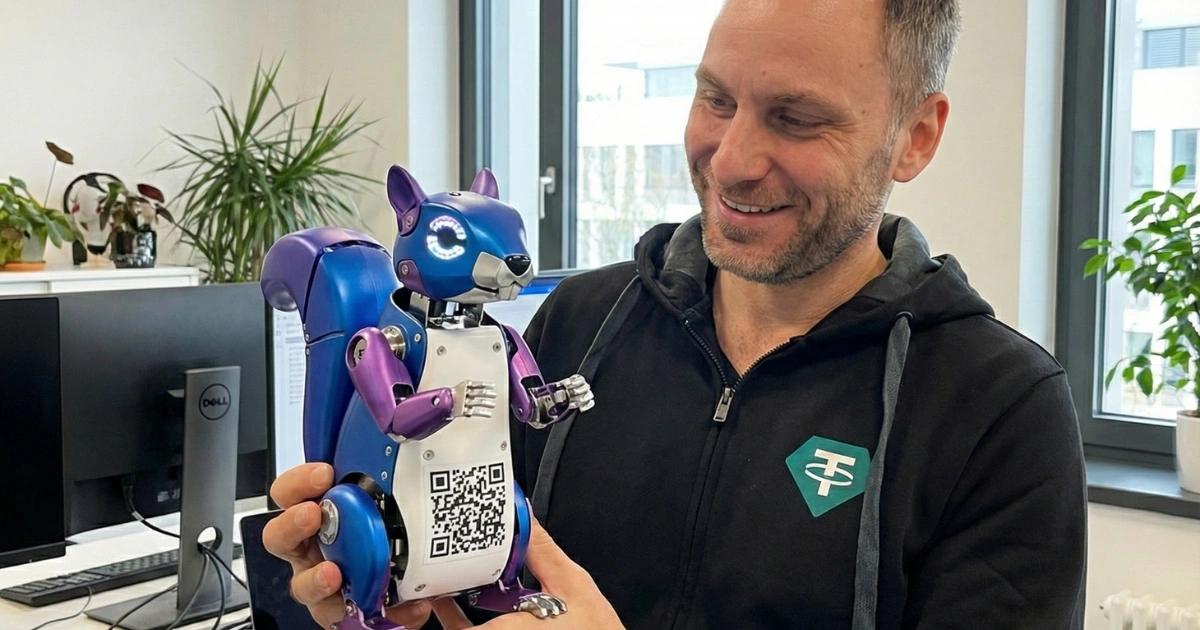
Tether invests in SQRIL, betting on the underlying infrastructure of cross-border QR payments, without pushing USDT, focusing on long-term strategies and regulatory considerations in building banking infrastructure.
Not developing consumer-end products, Tether invests in the “underlying infrastructure” of payments
Stablecoin issuer Tether recently invested in Southeast Asia’s cross-border payment startup SQRIL, drawing market attention. However, contrary to external expectations, this investment is not accompanied by any wallet products, $USDT traffic diversion, or consumer applications. Instead, Tether is choosing to bet on a set of “almost invisible” payment infrastructure.
Image source: SQRIL Stablecoin issuer Tether recently invested in Southeast Asia’s cross-border payment startup SQRIL
SQRIL focuses on creating an API-based payment exchange layer that allows banks’ apps, e-wallets, or fintech platforms in different countries to directly scan and pay for QR codes from other nations. Users pay in their local currency, and merchants receive local currency instantly, with currency exchange and clearing processes handled entirely by SQRIL in the backend. The entire process does not involve crypto assets and does not require end-users to change their payment tools. Its positioning clearly leans toward financial institutions and platform providers rather than retail markets.
Why QR Code, and focusing on Asia, Latin America, and Africa
In most Asian countries, QR code payments have long penetrated daily life. From the Philippines, Vietnam, Indonesia to Thailand, scanning codes for payments is mainstream, often based on national standards supported by central banks or regulatory agencies.
Similar real-time payment systems are also rapidly expanding in Latin America and Africa, even growing faster than credit card infrastructure. However, these systems almost all operate smoothly only within “domestic” borders. Once cross-border consumption or travel scenarios are involved, the payment experience immediately breaks down. SQRIL’s role is to fill this gap, quietly connecting incompatible national QR systems in the backend.
Currently, SQRIL supports QR payments in the Philippines, Vietnam, and Indonesia, and provides bank transfer services in Malaysia and Thailand. Future plans include expanding functionalities to more Asian, African, and Latin American markets, but actual success heavily depends on whether banks and wallet providers are willing to integrate its API.
Not pushing stablecoins, but more in line with Tether’s usual style
Notably, SQRIL’s payment process currently shows no sign of $USDT or any stablecoins. Tether’s investment appears not to be aimed at short-term promotion of crypto payments but rather betting on the strategic value of “payment infrastructure itself.”
This aligns with Tether’s recent movements. Besides stablecoin operations, Tether has invested resources into AI, data sets, and foundational technology industries, such as expanding and open-sourcing its QVAC Genesis II language model database for large language model research. At the same time, Tether has also revealed that it is exploring a mobile wallet centered on Bitcoin and $USDT , designed to operate AI models on-device with a non-custodial architecture.
The commonality of these layouts is that they do not directly compete for user attention but are positioned at the “core” of products, providing foundational capabilities for future application ecosystems. SQRIL clearly fits this investment logic.
Further reading
Tether ventures into AI health tech! How does QVAC Health integrate biological data while safeguarding your privacy?
Tether to launch a crypto wallet app! Integrating local AI assistants, supporting only Bitcoin and 3 stablecoins
A neutral connector role, but still cannot escape regulatory realities
Unlike large payment networks, SQRIL does not issue accounts, manage user relationships, or attempt to build a brand-based checkout experience. Instead, it positions itself as a “neutral connector.” This low-profile positioning makes it easier to be accepted by banks and regulators in various countries, especially in emerging markets that are highly cautious about foreign payment systems.
However, technology is not the only barrier. Payment regulation is inherently highly localized; each country has different rules regarding settlement, foreign exchange, compliance, and transaction monitoring. SQRIL can connect systems but cannot unify regulatory regimes. As it expands into Africa and Latin America, this complexity will only increase.
Overall, Tether’s investment in SQRIL seems more like a long-term infrastructure bet rather than an immediate crypto payment revolution. If successful, it will operate quietly within the global payment system; if it fails, it will leave no obvious consumer traces. For Tether, this might be the most ideal risk profile.
Disclaimer: The information on this page may come from third parties and does not represent the views or opinions of Gate. The content displayed on this page is for reference only and does not constitute any financial, investment, or legal advice. Gate does not guarantee the accuracy or completeness of the information and shall not be liable for any losses arising from the use of this information. Virtual asset investments carry high risks and are subject to significant price volatility. You may lose all of your invested principal. Please fully understand the relevant risks and make prudent decisions based on your own financial situation and risk tolerance. For details, please refer to
Disclaimer.
Related Articles
Tether launches open-source local AI toolkit QVAC SDK
Tether launched the open-source software development kit QVAC SDK on April 9, supporting running AI applications locally, compatible with multiple platforms, with features such as text generation and speech processing, and enabling peer-to-peer distribution via Holepunch. In the future, it will add decentralized training and toolkits tailored for robots.
GateNews5h ago
Tether launches open-source AI toolkit QVAC SDK, positioning it as a general-purpose artificial intelligence foundation module
Tether’s QVAC team launched the QVAC SDK, which is an open-source, cross-platform AI development toolkit aimed at building the intelligent ecosystem of the future and supporting a wide range of devices. QVAC is seen as a next-generation intelligent framework with modular and infinitely extensible features to adapt to future development.
GateNews8h ago
A CEX co-founder donates $5.4 million to the UK’s Reform UK party
A CEX co-founder, Ben Delo, donated $5.4 million to the Reform UK party, and the donation took place before new UK regulations came into effect. Delo was previously fined $10 million for violating anti–money laundering compliance and received a pardon from Donald Trump. Reform UK positions itself as a pro-cryptocurrency political party and is currently facing a pause order on crypto donations. After relocating to the UK, Delo plans to be exempt from donation limits.
GateNews9h ago
ZachXBT discloses internal payment server data from North Korean IT workers, involving a $3.5 million flow of funds
On-chain detective ZachXBT revealed that an anonymous source shared stolen data from North Korea’s internal payment servers, involving 390 accounts and encrypted transaction information. More than $3.5 million in funds vanished, and it is connected to a sanctioned company. ZachXBT has compiled a detailed organizational chart.
GateNews04-08 13:46
Tether CEO: The team is developing a decentralized search engine, hypersearch.
Gate News message. April 7, Tether CEO Paolo Ardoino said the team is developing a decentralized search engine called hypersearch. The product is built on a distributed hash table (DHT, a decentralized data storage technology) architecture.
GateNews04-07 13:51


