As the broader crypto market enters a transitional phase, major assets like Ethereum and SUI coin are showing signs of stabilization—but without clear directional conviction. For investors, the key question is whether to wait for technical confirmation or look for opportunities with predefined entry structures. Current market data suggests Ethereum remains range-bound, while SUI price prediction hinges on its ability to reclaim critical resistance zones.
Ethereum Price Today: Holding Support but Lacking Momentum
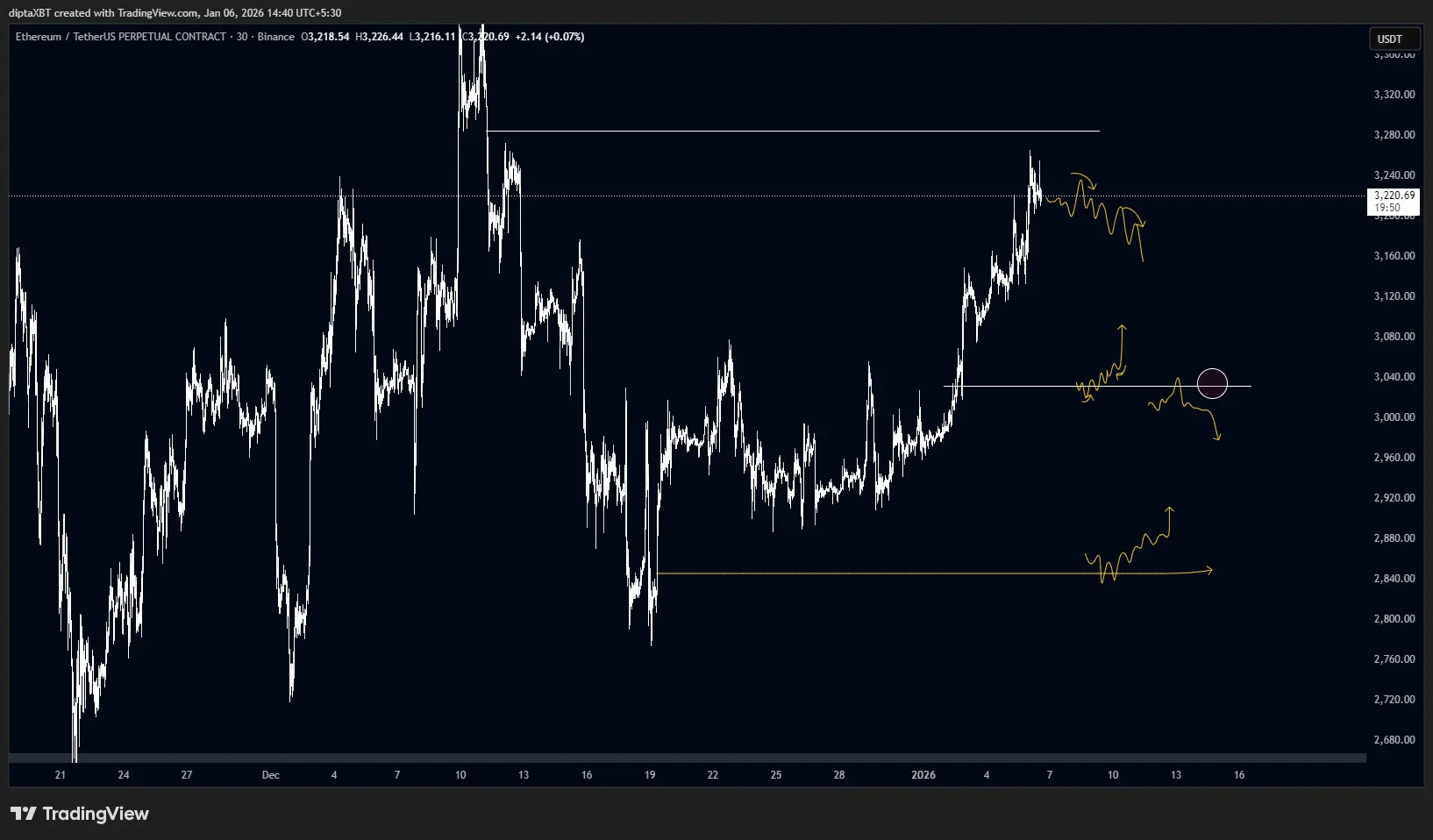
Ethereum price today continues to trade above the $3,100 level following recent volatility. While this support has held, technical signals point to uncertainty rather than strength. On lower timeframes, analysts have identified a potential Head and Shoulders formation, with the neckline forming near the $2,500 area. A decisive breakdown below this level could expose Ethereum to a deeper retracement toward the $2,000 region.
(Sources: TradingView)
Despite this risk, institutional interest remains intact. Large-scale ETH accumulation by treasury-focused firms has provided downside support. However, Ethereum still faces heavy resistance between $3,250 and $3,470. Until price action clears these zones with volume confirmation, Ethereum remains in a consolidation phase.
From a positioning perspective, Ethereum holders are effectively waiting—for confirmation, for momentum, and for broader market alignment. In the short term, Ethereum price action reflects balance, not acceleration.
SUI Coin Recovery: Early Strength, But Resistance Defines the Outlook
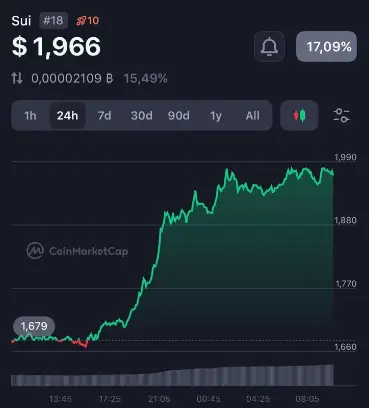
SUI coin has recently shown signs of recovery after revisiting a long-term weekly demand zone. Price structure indicates selling pressure has slowed, with tighter candle ranges suggesting accumulation. According to several market observers, SUI ranked among the stronger-performing altcoins during the latest rebound, supported by renewed ecosystem liquidity.
(Sources: CoinGecko)
From a SUI price prediction standpoint, the next phase depends on resistance behavior. The first critical supply zone lies between $1.90 and $2.10, an area that previously acted as structural support before breaking down. A successful reclaim could open the path toward the $3.10 region, which aligns with prior market structure highs.
On the fundamentals side, SUI’s total value locked recently recovered above $1 billion, signaling renewed on-chain activity. Additional visibility came from its inclusion in upcoming institutional-facing crypto products. Still, recovery does not equal confirmation. For SUI coin holders, the path forward requires patience and sustained buying pressure across multiple resistance levels.
Waiting Versus Defined Entry Structures in the Current Market
Both Ethereum and SUI present familiar scenarios in crypto cycles: technically sound assets navigating consolidation and early recovery. However, neither offers guaranteed timing. Ethereum must resolve resistance overhead, while SUI price prediction remains contingent on follow-through above key zones.
This environment highlights a broader market dynamic—waiting carries opportunity cost. Sideways price action generates no yield, and technical setups can take weeks or months to resolve. For many participants, this has renewed interest in assets with structured entry points and predefined accumulation mechanisms, especially during uncertain market phases.
Ethereum, SUI, and the Broader Market Outlook
Looking ahead, Ethereum’s long-term fundamentals remain strong, but short-term price direction depends on breaking multi-week resistance. A sustained move above $3,470 would materially improve bullish probability. Until then, Ethereum price today reflects equilibrium rather than trend.
For SUI coin, upside potential exists, but only if price confirms strength above $2.10 and maintains higher lows. Failure to do so would likely result in continued range trading. As such, most SUI price predictions remain conditional rather than definitive.
Final Thoughts
Ethereum and SUI continue to command attention as established layer-one networks with active ecosystems. However, current price structures suggest both are still in “waiting mode,” requiring confirmation before a directional trend emerges.
In a market defined by consolidation, investors are increasingly weighing the cost of passive speculation against alternatives offering clearer structure. Whether choosing to wait for Ethereum’s breakout, betting on a sustained SUI coin recovery, or exploring other accumulation strategies, the coming weeks will be decisive in determining which assets transition from patience to performance.
Disclaimer: The information on this page may come from third parties and does not represent the views or opinions of Gate. The content displayed on this page is for reference only and does not constitute any financial, investment, or legal advice. Gate does not guarantee the accuracy or completeness of the information and shall not be liable for any losses arising from the use of this information. Virtual asset investments carry high risks and are subject to significant price volatility. You may lose all of your invested principal. Please fully understand the relevant risks and make prudent decisions based on your own financial situation and risk tolerance. For details, please refer to
Disclaimer.
Related Articles
ETH Short-term Decline of 0.74%: Institutional Rebalancing and Short-term Profit-Taking Drive Selling Pressure
On March 16, 2026, from 06:00 to 06:15 (UTC), ETH experienced significant volatility within a 15-minute period, with a return of -0.74%. The price fluctuated between 2260.98 and 2281.3 USDT, with an amplitude of 0.89%. During this time, trading volume noticeably increased compared to the previous cycle, market volatility intensified, and community attention was drawn.
The main drivers of this volatility were large on-chain ETH transfers and substantial sell orders on the exchange, suspected to be institutional or whale portfolio rebalancing activities during this window, which directly led to short-term downward pressure on the price. Simultaneously, order book depth decreased, buy-side support diminished, and large individual trades further contributed to the market instability.
GateNews25m ago
Former ShapeShift CEO spends $56 million to buy Ethereum, ETH whale accumulation signals attract market attention
Former ShapeShift CEO Erik Voorhees has made a significant increase in Ethereum holdings, purchasing approximately 24,968 ETH worth around $56.5 million in total value, demonstrating his confidence in Ethereum's long-term value. Simultaneously, he has also allocated $23.7 million in tokenized gold assets. Recently, the Ethereum market has been active due to institutional capital inflows, with prices rising to approximately $2,265.
GateNews28m ago
Ethereum Foundation Unveils Public Charter! Defines Itself as Sanctuary Technology, Anti-Censorship, Privacy, and Open Source as Top Priorities
The Ethereum Foundation released a 38-page charter aimed at defending individual technological sovereignty and decentralization. They positioned Ethereum as "sacred technology," emphasizing privacy and security, and proposed the concept of "subtractive governance," committed to enhancing decentralization and allowing the Ethereum ecosystem to evolve autonomously. The charter also emphasized requirements for Layer2 scaling solutions, rejecting centralized designs to ensure Ethereum's future development.
CryptoCity41m ago
Bitcoin ETF Capital Inflows Drive Strong Rebound, Analysts Target $80,000
Bitcoin has rebounded approximately 2.5% in recent days, reaching a high of $74,000, primarily driven by consecutive five-day net inflows into U.S. spot ETFs totaling $767.3 million. Analysis indicates this rebound stems from spot ETF capital inflows, short covering, and active institutional buying. While the rebound has been strong, analysts remain cautious about a sustained bull market long-term, with the key factors being the sustainability of capital inflows and easing geopolitical tensions.
MarketWhisper50m ago
Ledger Executives: US Stablecoin Yield Ban Creates Opportunities for Overseas Issuers
Shigeyoshi Shibayama pointed out that if the United States implements a stablecoin yield ban, it will prompt overseas issuers to seek alternative yield opportunities and impact the competitive landscape of the market. Meanwhile, Asian institutions show a stronger preference for tokenization over direct cryptocurrency investment, indicating that traditional financial institutions are taking a more cautious approach to blockchain technology. They are seeking efficiency improvements while mitigating volatility risks.
MarketWhisper1h ago


