
- Payments platform Payy Link has launched Payy Network, which it claims to be Ethereum’s first and only privacy-enabled, EVM Layer-2.
- **With a Privacy Layer, stealth transactions and native zero-knowledge proofs, the new network targets users to whom privacy is critical. **
Ethereum has been on a campaign to go back to its original mission, with decentralization and privacy featuring prominently on its priorities list, as we have reported. The network is now getting a big boost on the privacy front, with Payy Link launching “Ethereum’s first and only privacy-enabled, EVM Layer-2.”
In its documents, the company further described Payy Network as “the first EVM compatible stablecoin chain with privacy at every layer.”
Ethereum is for privacy. https://t.co/xnj0sWTC5K
— Ethereum (@ethereum) February 4, 2026
Payy believes that privacy can’t be an afterthought: it must be custom-built into the architecture of a network in a holistic and complete approach. On the new network, transfers of any ERC-20 tokens will be private by default and no smart contract changes are required.
Additionally, it supports all wallets on the Ethereum Virtual Machine (EVM) natively. This is an important feature as it guarantees that developers can build on Payy Network using their existing tooling, with privacy layered in without any changes to the EVM protocol.
It states:
In the past, privacy always had tradeoffs: bad UX, fragmented liquidity, limited compatibility. With Payy, privacy is invisible.
With the Payy Network, all transfers will happen directly inside the pool, with smart contract interactions then withdrawing from the pool to fresh addresses. The private transaction data then goes to off-chain Privacy Vaults, which developers can configure using RPC URL query parameters. It also comes with native zero-knowledge verification.
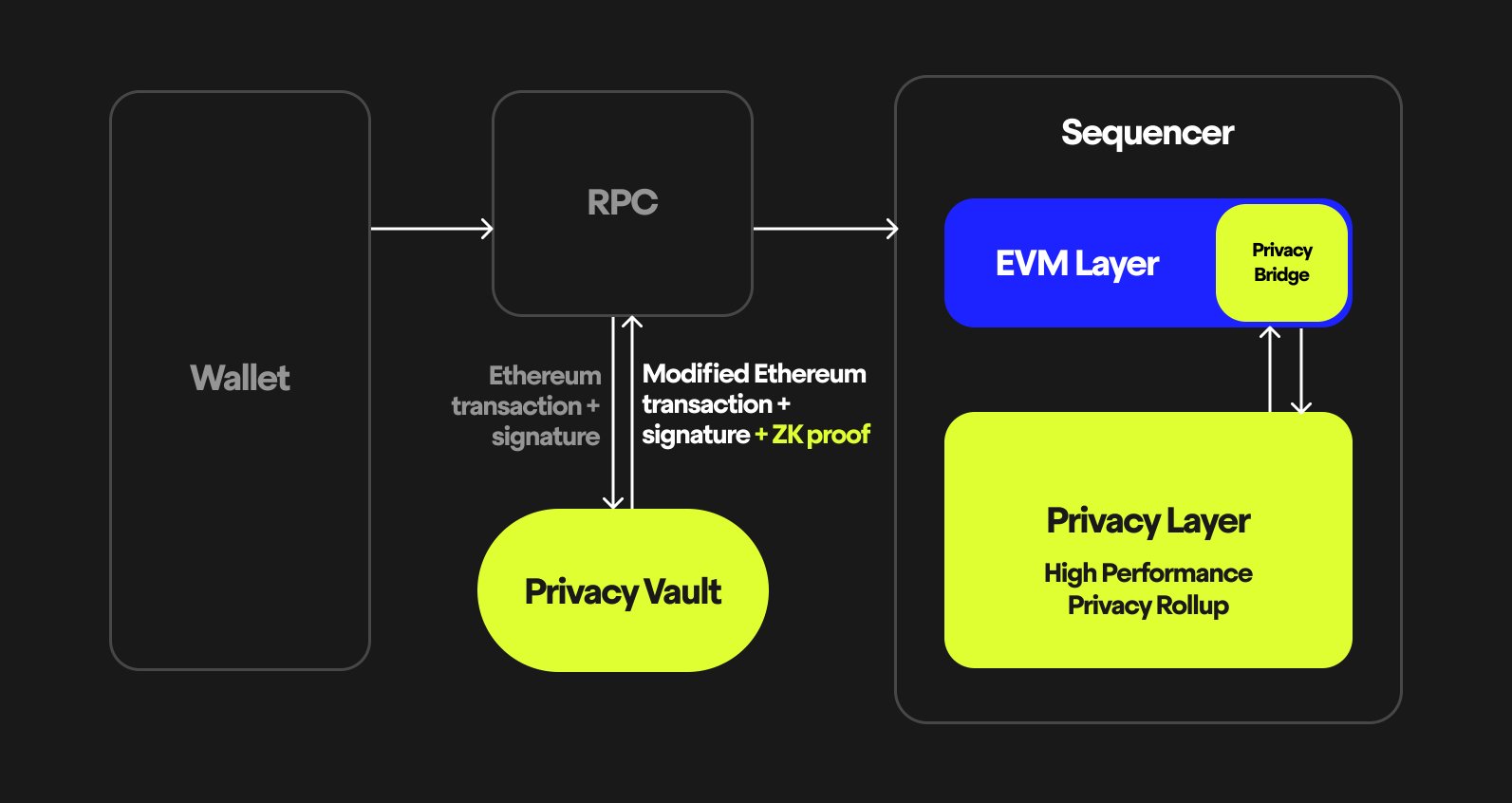
Image courtesy of Payy Link.
Native Ethereum Privacy on Payy Network
Payy Network offers three levels of privacy. The first is offered through the Privacy Layer, where payments are natively private even before they hit the EVM. Stealth Transactions then mint a new address for each new transaction, with the transaction conducted on the EVM layer, before the original tokens are then returned to the Privacy Layer. Moving funds in and out of this layer requires no gas fees, but minting the new address requires gas fees.
Then, there is native zero-knowledge technology, which users can tap depending on the privacy applications. Being native allows Payy Network’s ZK technology to cut down the cost that would otherwise be required; ZK tech on other networks consumes up to 10% of the available blockspace.
Essentially, Payy Network’s ZK proofs conduct their verification off-chain, allowing developers to build applications such as off-chain orderbooks like Hyperliquid, which has been predicted to hit $200 billion in market cap, as we reported.
They can also build dark liquidity pools and private real-world asset contracts.
The network will be powered by PUSD, a stablecoin backed by US dollars and available both as a native token and an ERC-20 token. Being a stablecoin, it guarantees that the fee for each transaction remains consistent.
Payy Link says the Payy Network is for crypto natives and funds to trade privately, and fintechs and tradfi that require extreme privacy for their transactions.
Disclaimer: The information on this page may come from third parties and does not represent the views or opinions of Gate. The content displayed on this page is for reference only and does not constitute any financial, investment, or legal advice. Gate does not guarantee the accuracy or completeness of the information and shall not be liable for any losses arising from the use of this information. Virtual asset investments carry high risks and are subject to significant price volatility. You may lose all of your invested principal. Please fully understand the relevant risks and make prudent decisions based on your own financial situation and risk tolerance. For details, please refer to
Disclaimer.
Related Articles
The White House approves cryptocurrency inclusion in 401(k) plans, opening the door to the $10 trillion retirement market.
The White House has completed regulatory review of the proposed rule by the Department of Labor, aimed at allowing 401(k) plans to invest in cryptocurrencies and paving the way for their entry into the retirement market. If approved, this rule will provide new investment options for digital assets, private equity, and more, marking an increase in the prominence of digital assets within traditional finance and having a significant impact on the retirement market.
GateNews46m ago
"Ma Ji" continues to open long positions after being liquidated again, with a total loss of $30.7 million.
BlockBeats News, March 26 — According to Onchainlens monitoring, as ETH drops below $2100, "Brother Maji" Huang Licheng's ETH long position was liquidated again, but he immediately opened a new ETH (25x) long position.
In addition, "Maji's" losses have now exceeded $30.7 million.
BlockBeatNews1h ago
ETH drops 1.56% in 15 minutes: Whales' on-chain fund flows and options expiration jointly trigger selling pressure
From 09:30 to 09:45 (UTC) on March 26, 2026, ETH price dropped by -1.56% within 15 minutes, with a price range of 2075.21 to 2116.99 USDT and a volatility of 1.97%. The market experienced clear fluctuations, on-chain trading volume surged, and market attention quickly intensified. Short-term capital accelerated flow, and derivatives market volatility increased, indicating the characteristics of a trend reversal under multiple structural pressures.
The main driver of this movement was whales collateralizing ETH through DeFi protocols to release liquidity, then transferring large amounts of funds into a major exchange, leading to
GateNews1h ago
Maji ETH long position was liquidated again, with total losses exceeding $30.7 million.
Gate News reports that on March 26, Onchain Lens monitoring showed that as the market declined, Magi's ETH long positions were fully liquidated again. After the liquidation, Magi immediately reopened a 25x leveraged ETH long position. As of now, Magi's total losses in this round of trading have exceeded $30.7 million.
GateNews1h ago


