Cross-chain protocol LayerZero announces the launch of a dedicated institutional blockchain called Zero, supported by Citadel Securities, Intercontinental Exchange, and Cathie Wood’s investments, aiming to process 2 million transactions per second, officially launching in September.
(Background: RWA protocol Ondo Finance’s viral success story: BlackRock and Morgan Stanley entering the real-world asset space)
(Additional context: US SEC terminates investigation into Ondo Finance with “no charges”—$ONDO surges past $0.5)
On the 10th, LayerZero announced the upcoming launch of a new blockchain called “Zero.” This is not another Layer 1 chasing retail funds, but an infrastructure designed from the ground up to target Wall Street.
According to Fortune magazine, this new chain has received strategic investment from the world’s largest market maker Citadel Securities, with Intercontinental Exchange (ICE) and securities clearing giant DTCC also participating. “Queen of stocks” Cathie Wood has joined the advisory board.
Zero-Knowledge Proofs Become the Gateway for Institutional Entry
Zero’s core technology is based on what’s called a “heterogeneous architecture,” using zero-knowledge proofs (ZKP) to separate transaction execution from verification. LayerZero claims this can achieve throughput of 2 million transactions per second, with a single transaction costing less than one-millionth of a dollar: about 100,000 times faster than Ethereum and roughly 500 times faster than Solana.
Whether these numbers are exaggerated remains to be seen after launch in September. But the focus isn’t whether LayerZero’s technology can truly deliver on its promises; it’s about what language it chooses to speak with Wall Street. Cathie Wood commented:
Zero is a breakthrough for blockchain entering mainstream markets, helping institutions overcome technical barriers to adoption.
DTCC will explore how to leverage Zero architecture to enhance its tokenization services; ICE is evaluating whether Zero can support 24/7 trading and integration of tokenized collateral; Google Cloud is partnering with LayerZero to explore real-time micro-payments via AI agents.
The Battle for Control of Crypto Infrastructure
Zero plans to launch in fall 2026 with three initial “regions”: a compatible EVM environment, a privacy-focused payment zone, and a dedicated cross-asset trading zone. This modular design allows different types of institutions to choose environments best suited to their needs while sharing LayerZero’s cross-chain interoperability.
However, as traditional financial institutions begin directly participating in blockchain infrastructure development, how much meaning remains in the term “decentralization”? Zero will be a “permissionless, verifiable, build-and-trade” network, but its design goals, partners, and governance structure clearly prioritize institutional needs.
This may not be a bad thing. For blockchain technology to truly transform financial infrastructure, it will eventually need to coexist with traditional finance players. But it also means that the future blockchain world might not be a flat structure governed collectively by miners, validators, and communities, but a layered system dominated by institutional capital, with retail participants involved but lacking influence.
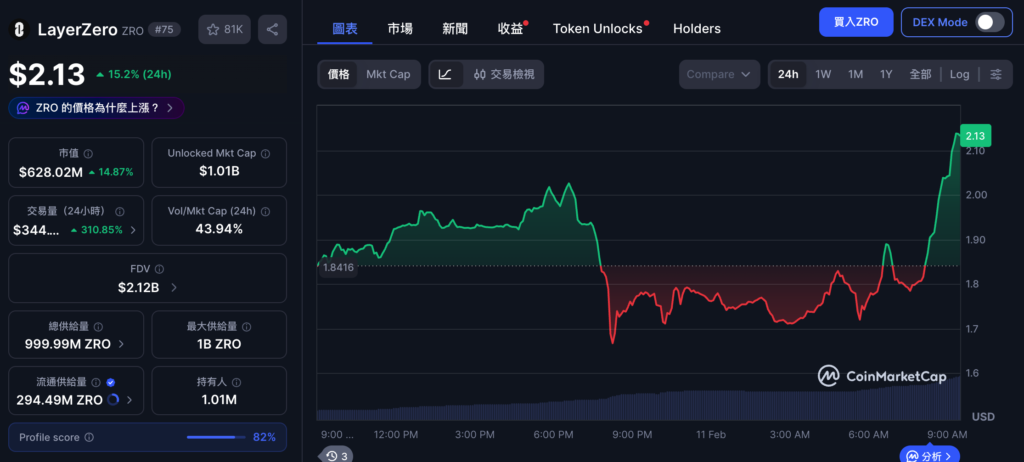
Zero will use the ZRO token for governance and staking. Its initial plans include an EVM-compatible zone, a privacy payment zone, and a trading zone. Driven by this, ZRO has surged over 15% in the past 24 hours.

Disclaimer: The information on this page may come from third parties and does not represent the views or opinions of Gate. The content displayed on this page is for reference only and does not constitute any financial, investment, or legal advice. Gate does not guarantee the accuracy or completeness of the information and shall not be liable for any losses arising from the use of this information. Virtual asset investments carry high risks and are subject to significant price volatility. You may lose all of your invested principal. Please fully understand the relevant risks and make prudent decisions based on your own financial situation and risk tolerance. For details, please refer to
Disclaimer.
Related Articles
Veteran Investor Simon Dixon Criticizes Michael Saylor's Bitcoin Accumulation Strategy
Veteran investor Simon Dixon criticized Michael Saylor's Bitcoin accumulation strategy, arguing that it may exacerbate Bitcoin centralization risks. He called for a return to self-custody and long-term holding rather than concentrated allocation through publicly traded companies.
GateNews2m ago
Crypto Market Records Modest Gains As Mixed Sentiment Prevails
The crypto market has seen a 1.35% rise, reaching a $2.44T capitalization, despite a 21.65% drop in volume. Bitcoin and Ethereum experienced gains, while top gainers included $GPM, $TRUMP, and $PEPE. DeFi TVL and NFT sales also surged, with key purchases and services announced.
BlockChainReporter33m ago
NFT Buyers This Week Doubled, Ethereum Sales Remain Top Position
This week, the NFT market showed active trading with buyer numbers growing 100.75% to reach 236,771 people, and seller numbers increasing 141.83% to 295,021 people, but total transaction volume declined 31.63% to 903,279 transactions. Ethereum and Polygon performed outstandingly, particularly with Polygon's Courtyard series experiencing significant sales growth. Analysis indicates that despite the increase in buyers, the average purchase quantity per person has declined, resulting in limited overall sales growth.
GateNews1h ago
Robinhood Launches $1.5 Billion Stock Buyback Program as Stock Price Falls 39% by 2026
Robinhood Markets approved a $1.5 billion stock buyback program on March 24, aimed at enhancing shareholder confidence and optimizing capital returns. The plan will be implemented starting in the first quarter of 2026, with a timeline of approximately three years. This move reflects management's confidence in the company's long-term development and may help alleviate market pressure from stock price declines.
GateNews1h ago
Pump.fun Allows Creator Fees to Be Adjusted Only Once After Launch, Trading Volume Drops Significantly
Memecoin token issuance platform Pump.fun has updated its fee distribution mechanism, allowing token issuers to change the fee recipient only once, in order to prevent malicious manipulation. Community reactions are mixed; some users believe the change has limited impact. Platform activity and revenue have declined, with income and trading volume in 2026 dropping sharply, highlighting the need to optimize the incentive balance between creators and traders.
GateNews1h ago
South Korea's Cryptocurrency Outflows Reach $60 Billion in Second Half of 2025, Exchange Profits Plummet
The South Korean Financial Services Commission report indicates that cryptocurrency outflows will reach $60 billion in the second half of 2025, primarily flowing to overseas platforms, while local exchange user numbers are growing but profits are declining. The total market capitalization and trading volume of the crypto market are expected to decline, with investors focusing on the impact of international markets and geopolitical factors on prices.
GateNews2h ago


