Grayscale’s latest report indicates that Bitcoin’s correlation with software technology stocks has reached as high as 0.73, making it more akin to a high-risk growth asset in the short term rather than a safe-haven instrument.
(Background recap: Bitcoin recovers the $70,000 level—analyzing the fragile logic behind analysts’ views on the rebound)
(Additional context: Michael Saylor “We will not sell”: Strategy shows a $6.5 billion unrealized loss but still insists on always buying Bitcoin)
Zach Pandl, Head of Research at Grayscale, released a report today (11) stating that Bitcoin is at a “role evolution” critical point. Data shows that Bitcoin’s correlation with gold has fallen to a low point, while its 30-day rolling correlation with the software technology ETF (IGV) has soared to 0.73, indicating its market behavior is becoming more similar to high-risk growth assets.
While gold prices challenge the all-time high of $5,000 per ounce, Bitcoin continues to fluctuate alongside U.S. tech stocks. Pandl states:
Expecting Bitcoin to replace gold in such a short period is unrealistic.
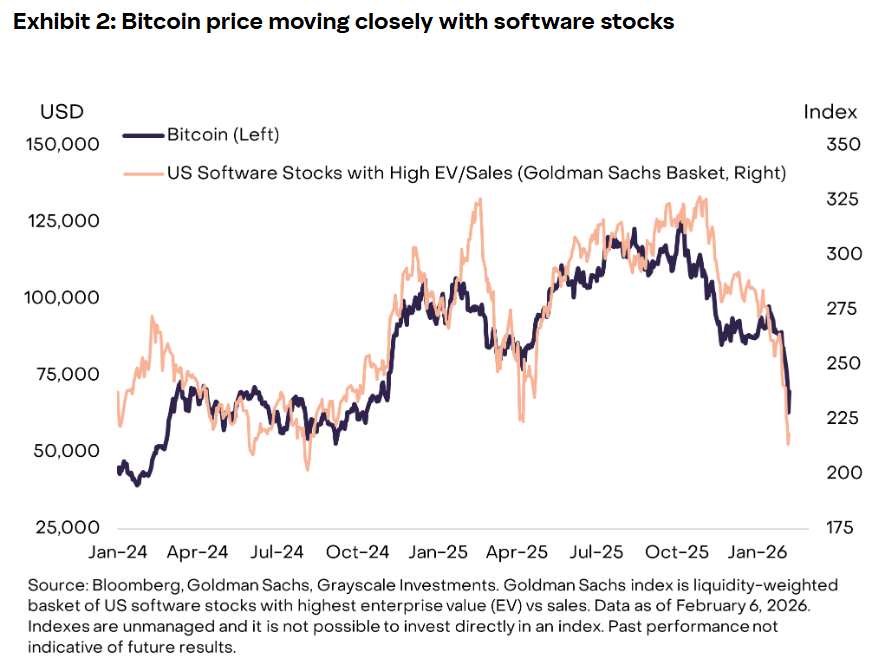
The Grayscale report further analyzes that the high correlation between Bitcoin and tech stocks mainly stems from the proliferation of ETF activity. As institutional funds flow heavily into Bitcoin via ETFs, this asset’s relationship with the traditional financial system becomes increasingly close.
When macroeconomic risks rise, institutions tend to sell off high-volatility assets like Bitcoin first, rather than viewing it as a safe haven.
AI Impact and Bitcoin?
Some analysts believe that the market views Bitcoin as a foundational growth asset for the future digital economy. Therefore, when artificial intelligence (AI) technology impacts traditional software services, Bitcoin also finds itself under pressure. This explains why Bitcoin is moving in tandem with software tech stocks under AI competitive pressures.
However, Grayscale sees this phenomenon not as a failure of Bitcoin as a store of value, but as an inevitable stage of its integration into the traditional financial system. The report notes that gold has held a monetary role for thousands of years and remained a pillar of the international monetary system until the early 1970s. In contrast, Bitcoin, with only 17 years of history, is currently in an “adaptation and evolution phase.”
Overall, Grayscale remains optimistic about Bitcoin’s long-term prospects. The report suggests that as the global economy continues to digitize and tokenize, Bitcoin will evolve toward a long-term store of value. However, investors should recognize that during this transitional phase, Bitcoin’s market performance is likely to resemble that of a high-risk growth asset rather than a traditional safe haven.

Disclaimer: The information on this page may come from third parties and does not represent the views or opinions of Gate. The content displayed on this page is for reference only and does not constitute any financial, investment, or legal advice. Gate does not guarantee the accuracy or completeness of the information and shall not be liable for any losses arising from the use of this information. Virtual asset investments carry high risks and are subject to significant price volatility. You may lose all of your invested principal. Please fully understand the relevant risks and make prudent decisions based on your own financial situation and risk tolerance. For details, please refer to
Disclaimer.
Related Articles
Analyst: If Bitcoin falls below the $66,000 support level, it may trigger a 10%-20% correction
Gate News reported that on March 20, Chartered Market Technician (CMT) Aksel Kibar stated on March 21 that the lower support boundary of Bitcoin's potential rising wedge formation is located at 66,000, and a breakdown below this level could trigger a bearish reversal. Aksel Kibar pointed out that rising wedges, as a classic technical pattern, typically appear at the end of uptrends, signaling price momentum exhaustion. Historical data shows that after similar downside breakdowns are confirmed, the average pullback ranges from 10%-20%.
GateNews13m ago
Bitcoin Slips Below $70,000 as Fed Rate Pause and Oil Surge Pressure Markets
Bitcoin declined to $70,000 due to steady interest rates from the Federal Reserve and rising energy prices, leading to $600 million in liquidations and increased market volatility, particularly affecting altcoins.
CryptoBreaking58m ago
XRP Climbs 3% Past $1.47 as Breakout Extends on Bitcoin-Led Rally
Key Takeaways
XRP broke above $1.426 resistance after months of consolidation, jumping to $1.47 on surging volume
Trading volume spiked over 250% during the move, indicating strong participation in the breakout
Activity on the XRP Ledger continues climbing, with tokenized real-world assets
CryptoBreaking1h ago
BTC down 0.65% in 15 minutes: Large spot selling orders dominate short-term pullback, panic sentiment intensifies volatility amplification
2026-03-20 13:45 to 2026-03-20 14:00 (UTC), BTC declined 0.65% within 15 minutes, with price range fluctuating between 69795.3 to 70399.4 USDT, reaching an amplitude of 0.86%. Market volatility intensified in the short term, trading activity increased, and investor attention rose.
The main driver of this price movement was concentrated large-scale active selling in the spot market. During this period, major trading platforms saw multiple large sell orders exceeding 100 BTC each, with sell orders accounting for 52% of volume, directly driving prices downward.
GateNews2h ago


