
The world’s largest Bitcoin institutional holder, MicroStrategy (MSTR), CEO Michael Saylor, recently publicly refuted the theory that quantum computing poses an imminent threat, stating that the cybersecurity community generally believes that credible quantum attack capabilities are still at least ten or more years away. He emphasized that once such a threat materializes, global digital infrastructure will upgrade collaboratively to respond, and the cryptocurrency community will play a leading role.
Saylor: Quantum Threats Are Overhyped

(Source: Coin Stories)
In the podcast Coin Stories, Saylor’s attitude toward quantum computing is surprisingly calm. He pointed out that all digital systems supporting modern society—including the global banking system, internet infrastructure, artificial intelligence networks, and various encryption protocols—will face the same quantum risks. Bitcoin is not a particularly vulnerable target but is one of many systems that require coordinated upgrades.
In his view, the transition to post-quantum cryptography is neither surprising nor will it happen suddenly. “You will see it coming, we will all see it coming,” Saylor said. He noted that Bitcoin’s software architecture is designed to evolve continuously over time, with nodes, hardware, and wallets all capable of upgrades to address emerging threats.
Why Does Bitcoin Have a Natural Advantage in Response?
Saylor presented three core points explaining that Bitcoin’s ability to respond to quantum computing threats is not inferior to traditional systems:
Stricter Security Standards: The verification processes required for Bitcoin transactions are far more rigorous than traditional bank wire transfers or stock trading systems, with multi-factor authentication and hardware keys being standard protections.
Fastest Community Response: The cryptocurrency field gathers the “most advanced cybersecurity communities,” which will be the quickest to perceive and respond if threats materialize.
Built-in Upgrade Mechanisms: The decentralized nature of global nodes allows Bitcoin to coordinate the deployment of post-quantum resistant cryptographic technologies when threats appear.
Industry Disagreement: Escalating Debate Over Threat Timeline
However, Saylor’s optimistic tone is not the consensus within the industry, and there are clear disagreements in the crypto community regarding the timeline of the quantum threat.
Ethereum founder Vitalik Buterin’s stance is much more urgent. He has publicly warned that the elliptic curve cryptography underpinning Ethereum and Bitcoin could face credible attacks by 2028, and called for the transition to post-quantum cryptography within four years. The Ethereum Foundation has incorporated post-quantum preparedness into its 2026 security roadmap and officially established a dedicated post-quantum research team this January, viewing it as a key strategic turning point.
Some even cite the quantum threat as an underlying reason for Bitcoin’s recent price decline. Bitcoin’s price has fallen from over $126,000 at its peak to around $64,000 now, a decline of over 49%. Nic Carter, partner at Castle Island Ventures, pointed out that Bitcoin’s “mysterious” poor performance can partly be attributed to market fears spreading over quantum risks.
In response, Glassnode analyst James Check remains cautious, believing that while quantum threats are worth preparing for in advance, they are not the “main reason” for this price drop. He suggests the market should not confuse short-term sentiment with long-term structural risks.
MicroStrategy Continues Buying: Action Is the Strongest Statement
(Source: MicroStrategy)
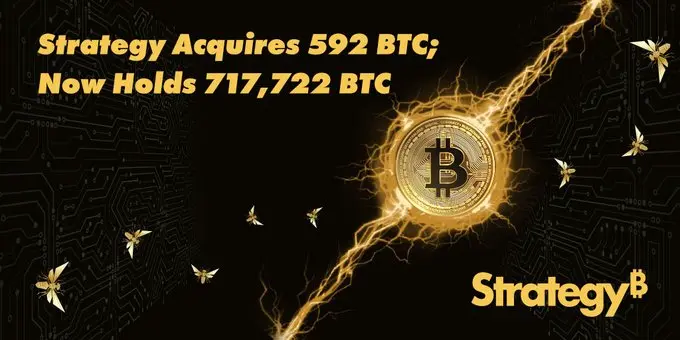
For Saylor, the most convincing argument may not be words but actions. MicroStrategy announced last week that it purchased approximately $39.8 million worth of 592 Bitcoin, marking its 100th transaction since adopting a Bitcoin-focused strategy in August 2020. Currently, the company holds a total of 717,722 Bitcoin, with a market value of about $54.56 billion, and an average cost basis of $67,286 per Bitcoin.
Such continuous accumulation is itself a direct response to the quantum threat theory—in Saylor’s framework, quantum computing is far from posing a threat capable of shaking Bitcoin’s foundation in the foreseeable future.
Disclaimer: The information on this page may come from third parties and does not represent the views or opinions of Gate. The content displayed on this page is for reference only and does not constitute any financial, investment, or legal advice. Gate does not guarantee the accuracy or completeness of the information and shall not be liable for any losses arising from the use of this information. Virtual asset investments carry high risks and are subject to significant price volatility. You may lose all of your invested principal. Please fully understand the relevant risks and make prudent decisions based on your own financial situation and risk tolerance. For details, please refer to
Disclaimer.
Related Articles
Coin Center Urges SEC to Establish Unified Crypto Rules, Opposes Reliance on Individual Case Exemptions
On March 18th, Coin Center sent a letter to the U.S. SEC, urging the prioritization of systematic cryptocurrency asset regulatory rules to avoid market fragmentation and unfairness. The letter pointed out that crypto networks should be considered public infrastructure. The SEC recently issued a classification for non-securities crypto assets and signed a memorandum of understanding with the CFTC, aimed at strengthening regulatory coordination. Coin Center warned that selective regulation could impact market fairness. The U.S. Congress is advancing the CLARITY Act, expecting to provide a clear compliance pathway for digital assets.
GateNews39m ago
Bitmine purchased an additional $142 million in ETH last week, with total holdings exceeding $10.7 billion USD
Bitmine, linked to crypto analyst Tom Lee, recently purchased $142 million in Ethereum, raising its total holdings to over $10.7 billion. It now holds 3.8% of total ETH supply and continues buying aggressively, prompting speculation about when this "whale" will stop.
TapChiBitcoin1h ago
SEC Chairman Paul Atkins Proposes Crypto Safe Harbor Framework to Provide Regulatory Exemptions for Token Issuances
U.S. SEC Chair Paul Atkins proposed launching a "safe harbor" exemption program to provide flexible compliance pathways for cryptocurrency companies, including "startup exemptions" and "financing exemptions." The SEC plans to release relevant rule drafts in the coming weeks to clarify the regulatory scope of crypto assets, which could attract more institutional capital into the market.
GateNews1h ago
Yesterday, the total net inflow for Ethereum spot ETFs was $138.28 million, with BlackRock's ETHA leading.
On March 17th, Ethereum spot ETFs saw a total net inflow of $138.28 million, with BlackRock's ETHA and ETHB recording net inflows of $81.72 million and $67.18 million respectively. Grayscale products also saw modest inflows on certain products, while Fidelity's FETH experienced a net outflow of $35.46 million. Net inflows from other brand products were zero.
GateNews1h ago
Citi Group Cuts BTC and ETH 12-Month Price Targets to $112,000 and $3,175
Citigroup has lowered its price forecasts for Bitcoin and Ethereum over the next 12 months due to the stagnation of U.S. cryptocurrency market legislation, with the Bitcoin target price reduced to $112,000 and Ethereum to $3,175, and has also revised down its expectations for ETF demand. Regulatory developments have a significant impact on the market.
GateNews2h ago
Gate Card Maximum 5% Cashback Rewrites Crypto Payment Rules, Tiered Rewards Benefit Global Users
Gate has recently launched the new Gate Card, offering up to 5% cashback and a dual-tier upgrade system, supporting over 100 countries and 130 million merchants. Users can select their preferred cashback currency and enjoy a monthly spending limit of 1.3 million USD, making it suitable for high-net-worth individuals. The card's 1% processing fee can be offset by cashback earned by premium users, enabling positive returns, and encouraging users to accumulate rewards through spending and VIP upgrades.
MarketWhisper2h ago


