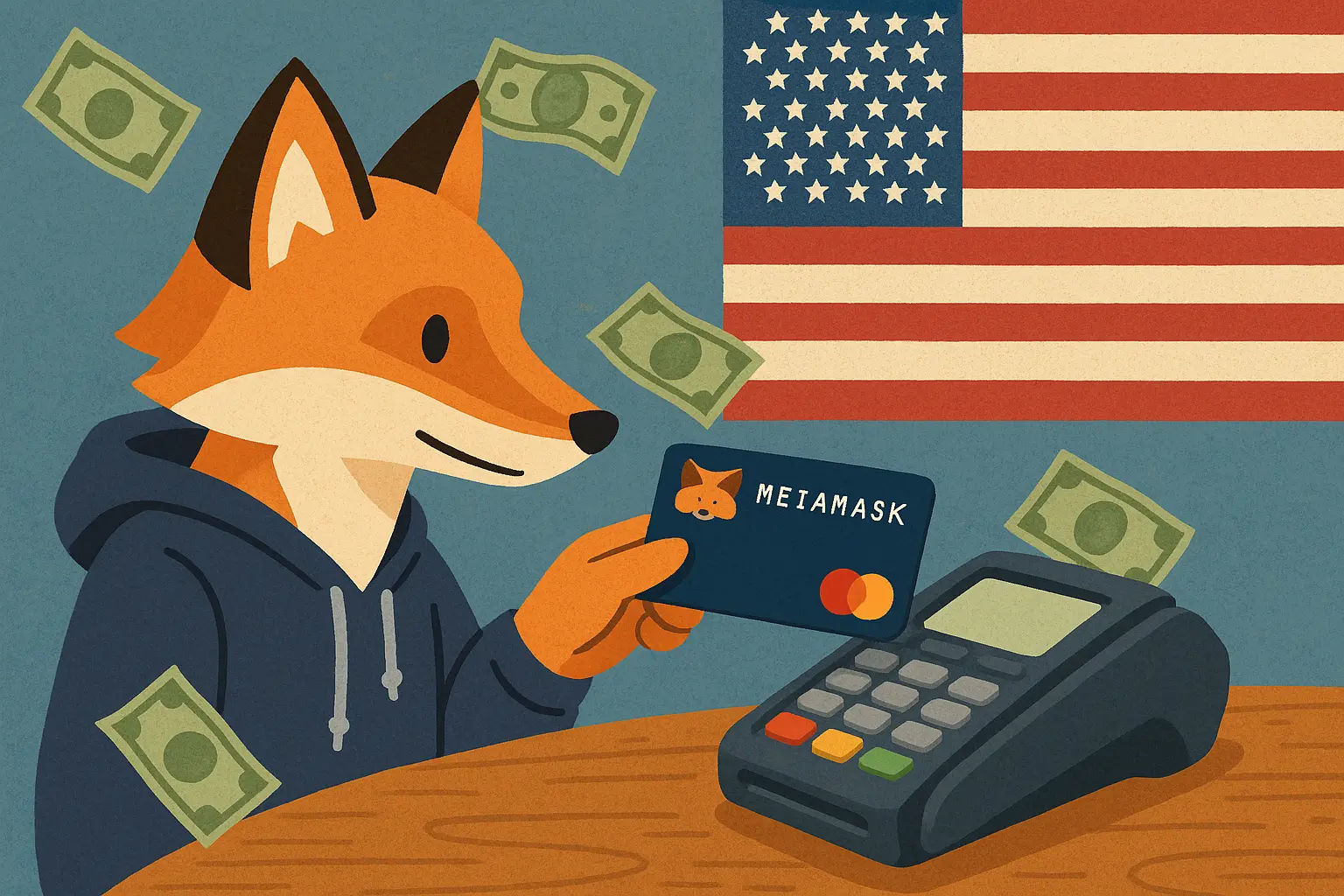
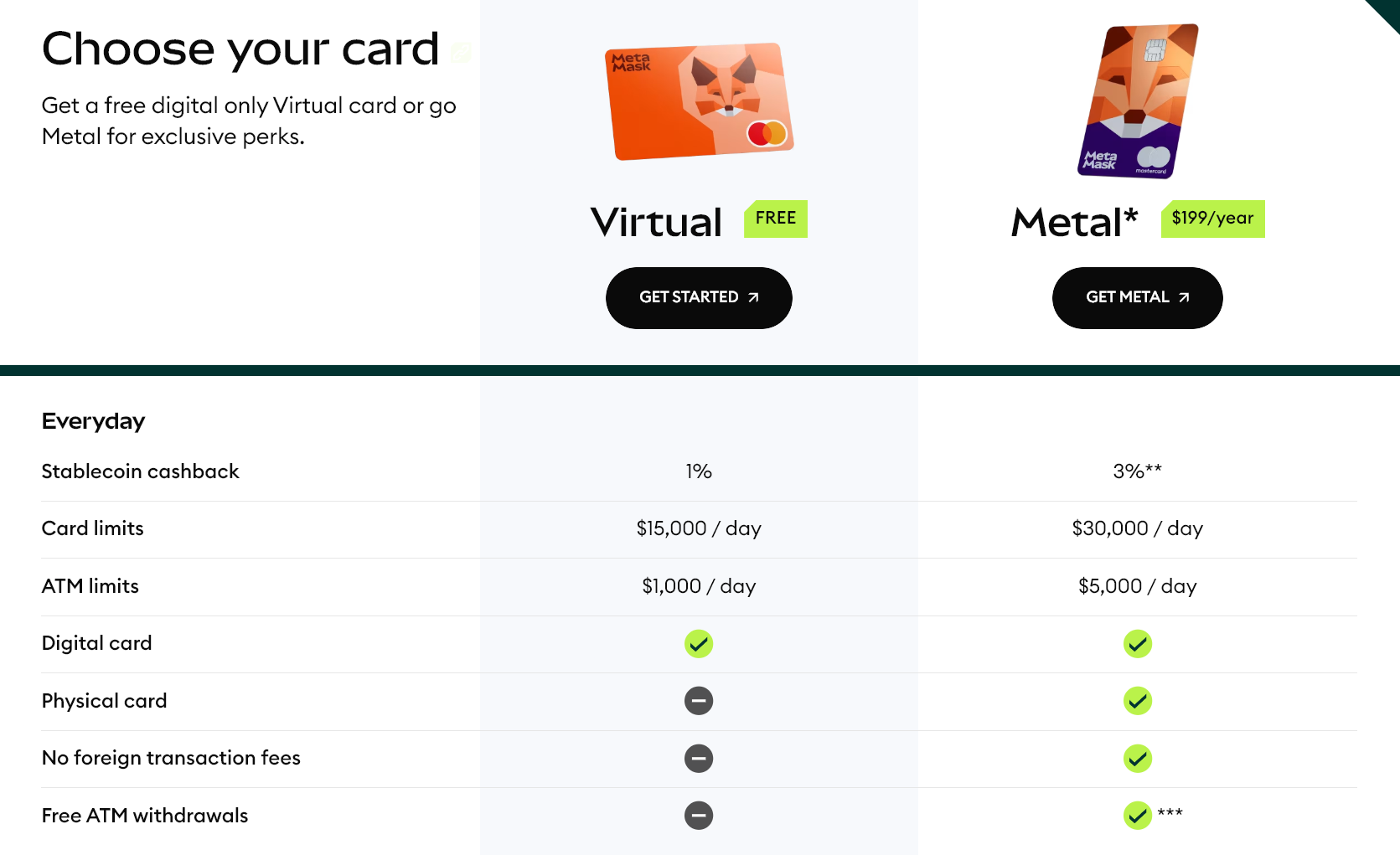
MetaMask announces partnership with Mastercard to officially launch a payment card program in the United States, offering instant-use virtual cards and metal physical cards now available for pre-order, with applications open to New York residents, covering one of the strictest states in U.S. cryptocurrency regulation. The metal card provides 3% cashback on the first $10,000 spent and waives foreign transaction fees.
Product Design: Extending Self-Custody Wallets to Everyday Spending Scenarios
 (Source: MetaMask)
The core design of the MetaMask Mastercard is to extend the experience of self-custody wallets directly into daily spending scenarios. Users manage on-chain assets through MetaMask and use this card to make fiat payments via Mastercard’s global merchant network, differing from traditional crypto cards that require users to hold funds on centralized exchanges.
Reward mechanisms convert users’ daily on-chain activities—including transfers, transactions, and spending—into points that can be redeemed for ecosystem benefits, including discounts, token allocations, and early access to new features. MetaMask positions this as a tool to attract users to stay within its ecosystem, rather than directing users toward centralized platforms.
It is especially noteworthy that residents of New York can apply for this card. New York State is known for its strict cryptocurrency regulatory framework (including the “BitLicense” system), which limits many crypto financial products from launching in the state. MetaMask’s decision to open applications to New York residents demonstrates a positive step toward compliance.
Details of Metal Card Features and User Considerations
Main features of the MetaMask Metal Card:
Cashback: 3% cashback on the first $10,000 spent
Foreign Transactions: No foreign transaction fees
On-Chain Points: Earn points through spending, transfers, and transactions, redeemable for ecosystem benefits and token allocations
Versions Available: Virtual card available for immediate use; metal physical card now open for pre-order
Eligibility: U.S. residents, including New York State
When evaluating actual value, users should consider: converting crypto to fiat at checkout may trigger taxable capital gains events; specific terms regarding eligible tokens, fees, spending limits, and network support will affect the actual benefit of the 3% cashback in daily use. MetaMask’s launch exemplifies crypto wallet providers beginning to directly compete in the payments space, amid major payment networks and fintech partners integrating stablecoins and on-chain balances into mainstream merchant spending scenarios.
Frequently Asked Questions
What are the fundamental differences between MetaMask Mastercard and traditional crypto payment cards?
The main difference lies in asset custody. Traditional crypto cards typically require users to hold funds on centralized exchanges, whereas MetaMask’s design keeps assets in the user’s self-custody MetaMask wallet, only settling fiat through the Mastercard network during transactions, theoretically giving users greater control over their assets.
What benefits can be obtained by exchanging on-chain points from MetaMask Mastercard?
According to official information, points can be redeemed for discounts, token allocations, and priority access to new features or ecosystem partner services. Specific exchange ratios, eligible tokens, and terms vary; users are advised to check MetaMask’s latest official details before applying to fully assess the actual value.
Will using MetaMask Mastercard generate tax obligations?
If transactions involve converting crypto to fiat, under current U.S. tax law, this operation may be considered a taxable capital gains event, even for small amounts. Users should consult tax professionals before extensive use to confirm their specific tax obligations in their jurisdiction and avoid missing reporting requirements.
Disclaimer: The information on this page may come from third parties and does not represent the views or opinions of Gate. The content displayed on this page is for reference only and does not constitute any financial, investment, or legal advice. Gate does not guarantee the accuracy or completeness of the information and shall not be liable for any losses arising from the use of this information. Virtual asset investments carry high risks and are subject to significant price volatility. You may lose all of your invested principal. Please fully understand the relevant risks and make prudent decisions based on your own financial situation and risk tolerance. For details, please refer to
Disclaimer.
Related Articles
Eigen Labs releases the Beta version of AgentKit, which supports the creation of autonomous AI agents that can hold assets.
Eigen Labs released the first Beta version of AgentKit on March 27, which is a toolkit for developers to create AI agents capable of independently managing identities and assets. The initial application scenario is autonomous media agents, with plans to expand integration with social platforms and add new features in the future.
BlockBeatNews17m ago
Filecoin Onchain Cloud launches the mainnet, providing developers with a programmable storage and payments layer
Filecoin has announced that its "on-chain cloud" has officially launched on the mainnet, providing a programmable storage and payment layer, and supporting data verification. The starting price for storage is $25,000 per TiB per month. Over 100 teams are already involved, storing 49.41 TiB of data, and a premium service level agreement will be launched in the future.
BlockBeatNews18m ago
Matsumoto Kiyoshi has joined! Japan’s drugstore association introduces tokenized deposits to further speed up payments and logistics efficiency
The Japan Chain Drugstore Association has introduced DCJPY tokenized deposits to reduce payment processing fees and improve logistics efficiency. This move demonstrates Japan's emphasis on blockchain and digital finance, and it collaborates with SBI Bank to provide new financial services. Additionally, DCJPY plans to expand into cross-border payments, partnering with Singaporean companies to connect to global markets.
CryptoCity38m ago
OpenAI resets Codex usage limits, first batch integrates development tools like Slack, Figma, and others.
Gate News reports that on March 27, Thibault Sottiaux, head of OpenAI Codex, announced that the usage limits for Codex across all plans have been reset to align with the newly launched plugin system. The first batch of integrated plugins includes commonly used developer tools such as Slack, Figma, Notion, and Gmail, allowing users to utilize Codex capabilities in more application scenarios. This move aims to encourage users to experience the newly launched plugin features.
GateNews1h ago
Hyperliquid ecosystem RWA DeFi protocol Felix launches tokenized stock and ETF trading.
The RWA DeFi protocol Felix in the Hyperliquid ecosystem has launched tokenized stock and ETF trading, partnering with OndoFinance. It supports over 250 assets and offers low-cost 24/7 trading services.
BlockBeatNews1h ago


