
Chief Investment Officer Iggy Ioppe of Theo pointed out that once the US futures market closes over the weekend, the public pricing of gold shifts to the blockchain network. Chicago Mercantile Exchange (CME) gold futures cease trading at 5 PM Eastern Time on Friday and resume at 6 PM Sunday, creating nearly a 49-hour “gold pricing gap,” making tokenized gold assets PAXG and XAUt the new global tracking assets.
CME Gold Futures Weekend Closure and Pricing Gap
(Source: CEX.IO)
Ioppe stated, “In terms of publicly visible price discovery, on-chain markets are almost 100% responsible for weekend gold price discovery.” After CME futures reopen, prices tend to align closely with the trends established on the blockchain markets over the weekend.
During CME’s closure, although OTC trading in Asia continues, these transactions are not publicly disclosed, lacking transparency. In contrast, all transactions of tokenized gold are visible on-chain in real-time, making it the only public channel for institutions to track weekend gold price movements.
This weekend’s Middle East crisis is a prime example. As the US and Israel launched military strikes on Iran, tokenized gold prices surged significantly: XAUT briefly broke above $5,450, and PAXG approached $5,536, while Bitcoin declined, demonstrating the independent safe-haven function of tokenized gold amid geopolitical crises.
Advantages and Use Cases of Tokenized Gold’s Weekend Pricing
Unique Public Pricing: During CME weekend closures, PAXG and XAUt nearly monopolize the public gold price discovery function.
Institutional Signal Tracking: Macro and cross-asset trading desks monitor on-chain markets to track gap risks before CME reopens.
Real-Time Rebalancing: Traders can immediately adjust positions during geopolitical events when traditional markets are closed.
Arbitrage-Driven Liquidity: Market makers maintain pricing efficiency by arbitraging price differences between digital and traditional markets.
Explosive Growth and Future Outlook of the Tokenized Gold Market
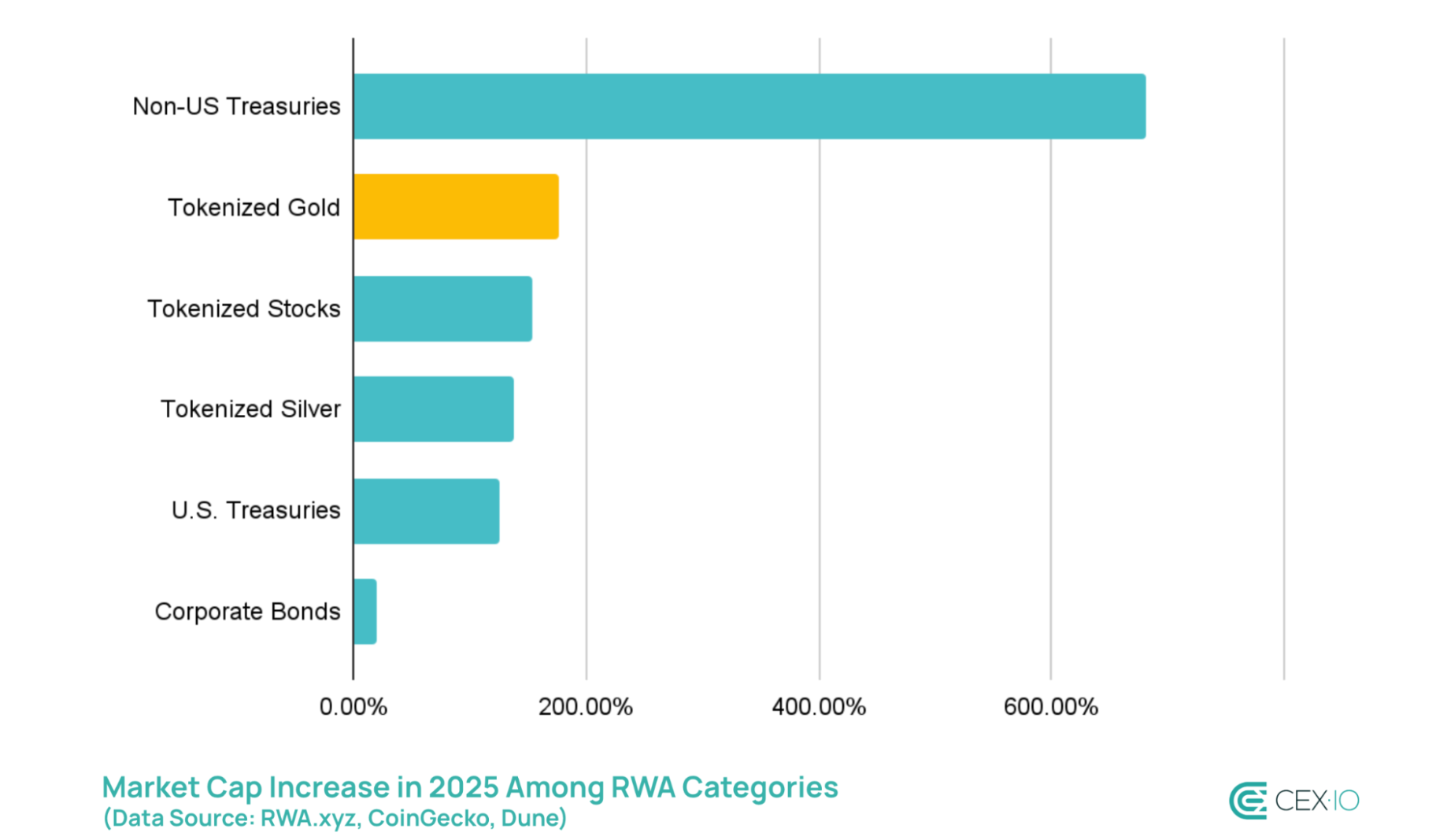
The market cap of tokenized gold grew from about $1.6 billion to $4.4 billion over the past year, an increase of 177%, far surpassing the overall gold market growth and most major physical gold ETFs. The number of holders nearly tripled, adding over 115,000 wallets, accounting for about a quarter of net inflows in the RWA sector, exceeding the combined growth of tokenized stocks, corporate bonds, and non-US government bonds.
In terms of trading volume, tokenized gold is projected to reach approximately $178 billion by 2025, with a peak of over $126 billion in Q4, making it the second-largest gold investment product globally, after SPDR Gold Trust.
However, Ioppe noted that there are still obstacles: liquidity for tokenized gold remains below that of futures or ETFs, making large transactions difficult; regulatory frameworks vary significantly across jurisdictions, hindering large-scale institutional adoption. He expects the tokenized market and traditional markets to coexist, each serving different functions.
Frequently Asked Questions
Q: Why is tokenized gold important during CME weekend closures?
CME gold futures are closed for nearly 49 hours over the weekend. During this period, Asian OTC trading continues but is not publicly disclosed. Tokenized gold (PAXG, XAUt) is among the few assets that continue trading and are publicly visible, thus nearly 100% responsible for weekend gold price discovery.
Q: How fast has the market cap of tokenized gold grown?
Over the past year, the market cap surged from about $1.6 billion to $4.4 billion, an increase of 177%, far exceeding most major gold ETFs’ growth during the same period. The number of holders nearly tripled, adding over 115,000 wallets, making it one of the largest growth engines in the RWA sector.
Q: What are the main challenges facing tokenized gold?
Major challenges include: liquidity still below that of traditional futures and ETFs, making large trades difficult; significant regulatory differences across jurisdictions; and disparities in custody, accounting, and capital rules worldwide, hindering large-scale institutional deployment.
Disclaimer: The information on this page may come from third parties and does not represent the views or opinions of Gate. The content displayed on this page is for reference only and does not constitute any financial, investment, or legal advice. Gate does not guarantee the accuracy or completeness of the information and shall not be liable for any losses arising from the use of this information. Virtual asset investments carry high risks and are subject to significant price volatility. You may lose all of your invested principal. Please fully understand the relevant risks and make prudent decisions based on your own financial situation and risk tolerance. For details, please refer to
Disclaimer.
Related Articles
XRP Price Action Hovers at Critical Support - U.Today
XRP is at a critical support level, with signs of potential reversal indicated by bullish divergence in the RSI. Despite a recent downtrend, strong retail demand is driving accumulation, setting XRP apart in a challenging market.
UToday6m ago
Bitcoin ETF Ends Seven-Day Winning Streak, Bitcoin Price Pressure Returns
US Bitcoin spot ETFs have turned to outflows following seven consecutive trading days of net inflows, indicating a shift toward more conservative capital allocation. Bitcoin price briefly fell below $70,000, reflecting weakened market sentiment and capital flows. ETF outflows stem from market reassessment of the macro environment, as investors reduce risk appetite amid elevated interest rate expectations and geopolitical risks. $70,000 has become a near-term technical dividing line between bulls and bears, with technical indicators suggesting market confidence still needs to be restored.
区块客10m ago
Analysts: Bitcoin and Gold Diverge, Central Banks and Retail Investors' Savings Logic "Decouples"
Bitcoin and gold are expected to diverge in their 2026 trajectories due to differences in their buyer demographics: gold is primarily driven by central banks and significantly influenced by geopolitical factors, while Bitcoin is predominantly held by individuals, offering advantages in circumventing traditional financial constraints. Analysts are divided on performance over the next three years, with Lyn Alden bullish on Bitcoin, while Ray Dalio believes gold maintains the advantage.
MarketWhisper13m ago
XRP Open Interest Drops 75%, But Stablecoin Fragmentation Intensifies XRP Bridge Demand
XRP open interest declined approximately 75%, indicating that leveraged traders are exiting the market, but stablecoin fragmentation may increase bridge demand for XRP. Evernorth Holdings' IPO application demonstrates that institutions still view XRP's long-term value positively. The overall market faces macroeconomic pressure, with weak short-term momentum structure.
MarketWhisper1h ago
Japanese Yen Rate Hike Hopeless? Japanese Bonds Collapse with "Yields at 27-Year High," Strait of Hormuz Conflict Strangling Japan's Economy
Japan's 10-year government bond yield rose to 2.32%, approaching a 27-year high, with markets concerned that geopolitical tensions will impact the economy and crypto markets. Trump's 48-hour ultimatum to Iran has sent energy prices soaring, and Japan's critical crude oil shipping routes face threats, potentially worsening inflation. The Bank of Japan faces a dilemma between rate hikes and economic recovery, while rising yields could trigger investor liquidations, impacting risk assets like Bitcoin.
動區BlockTempo1h ago


