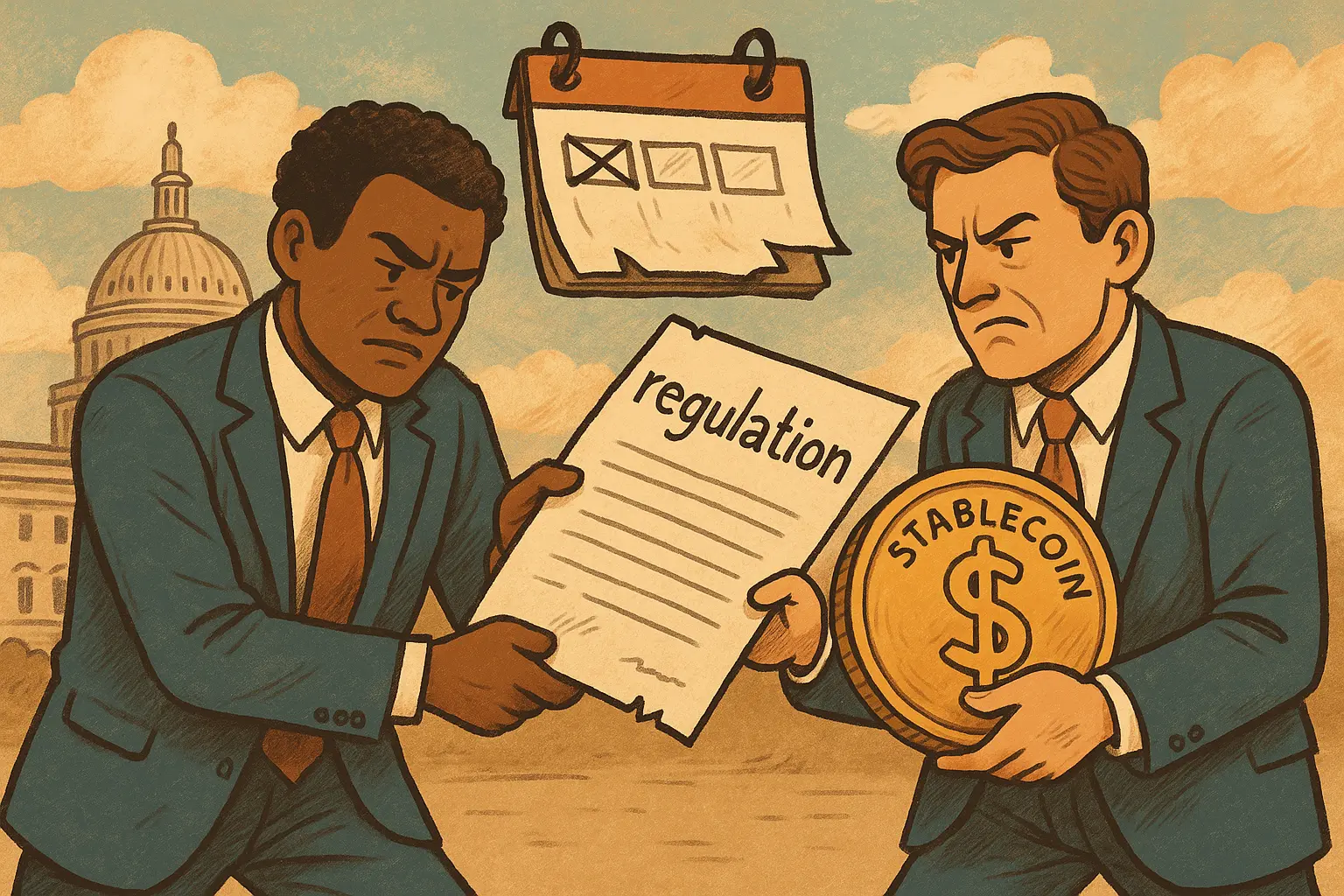
The March 1 deadline set by the White House Cryptocurrency Committee for stablecoin legislation has passed, but the stability coin provisions in the CLARITY Act remain stalled. The core disagreement centers on the issue of stablecoin yields: crypto companies want the legal right to offer users rewards on stablecoins, while banks are concerned about deposit outflows and strongly oppose any form of stablecoin yield arrangements.
Key Dispute Over Stablecoin Yields: Banks vs. Crypto Industry
The reason the stability coin provisions in the CLARITY Act have yet to reach consensus is the fundamental split over whether stablecoins can offer yields. Crypto firms seek the legal right to provide regulated rewards on mainstream stablecoins like USDC to attract and retain users.
Banks strongly oppose this: if users can earn 4% to 5% yields on stablecoins, compared to just 0.01% on traditional savings accounts, large deposit outflows could accelerate from traditional banks, posing systemic financial risks. An industry insider noted that most agree stablecoin balances should not generate interest directly, but crypto companies are still attempting to offer yields indirectly through “membership programs, rewards, and staking” — which banks see as circumventions that hinder negotiations. The Office of the Comptroller of the Currency (OCC) also hinted in its latest GENIUS bill rulemaking that stablecoin rewards might face stricter restrictions than crypto industry expects, indirectly strengthening the banks’ negotiating position.
Core Disputes in the CLARITY Act Stablecoin Provisions
Crypto Industry Demands: Legally offer regulated yield rewards to users holding stablecoins like USDC
Banks’ Resistance: Worry about deposit outflows, advocate for strict limits or outright bans on stablecoin yields
OCC Position: Implies stablecoin rewards will face tighter restrictions, supporting banks’ negotiation stance
Contingency Plan Disputes: Crypto’s “membership programs, staking, and rewards” are viewed by banks as de facto interest
Legislative Deadline: The White House-set deadline of March 1 has passed, and no compromise has been reached
Future of the CLARITY Act and Market Risks
Although the March deadline has passed, the legislative process for the CLARITY Act is not over, but the timeline is tightening. The Senate Banking Committee is expected to hold hearings in mid to late March, with preliminary negotiations tentatively starting in April, and a final deadline set for July — aiming to reach consensus before the election cycle to avoid prolonged political deadlock.
If the CLARITY Act cannot be enacted within this framework, the market faces two major risks: first, SEC and OCC may pursue enforcement actions to fill regulatory gaps, creating greater uncertainty; second, the large institutional capital inflow predicted by JPMorgan by the end of 2026 could be significantly delayed due to ongoing regulatory uncertainty.
Stablecoin legislation is widely viewed as a key prerequisite for mainstreaming cryptocurrencies in the U.S. If legislation stalls, regulatory uncertainty will continue to burden crypto firms, and innovative projects may continue migrating to regions with more favorable regulatory environments, such as Europe and Asia.
Frequently Asked Questions
Why did the CLARITY Act fail to pass before March 1?
The main obstacle was the disagreement over stablecoin yields. Crypto companies want the legal right to offer stablecoin rewards, while banks worry this could lead to deposit outflows. Both sides failed to reach consensus before the White House’s March 1 deadline, even through “membership programs, staking,” and other workarounds, which banks find difficult to accept.
What is the legislative timeline after the CLARITY Act?
The Senate Banking Committee is scheduled to review in mid to late March, with preliminary negotiations starting in April, and a final deadline set for July. If no agreement is reached before July, the U.S. could face a longer political deadlock due to the upcoming election cycle.
What impact does the stall in the CLARITY Act have on the market?
If legislation remains stalled, SEC and OCC may pursue enforcement actions to fill regulatory gaps, increasing market uncertainty. JPMorgan’s forecasted large-scale institutional inflows by the end of 2026 could be delayed, and more crypto projects might shift to regions with clearer regulatory frameworks.
Disclaimer: The information on this page may come from third parties and does not represent the views or opinions of Gate. The content displayed on this page is for reference only and does not constitute any financial, investment, or legal advice. Gate does not guarantee the accuracy or completeness of the information and shall not be liable for any losses arising from the use of this information. Virtual asset investments carry high risks and are subject to significant price volatility. You may lose all of your invested principal. Please fully understand the relevant risks and make prudent decisions based on your own financial situation and risk tolerance. For details, please refer to
Disclaimer.
Related Articles
Federal Reserve meeting minutes: Some participants pushed expectations for when rate cuts would begin further into the future
Gate News update: On April 8, the Federal Reserve meeting minutes (FOMC Minutes) showed that several participants further pushed back their assessment of when rate cuts would happen to a more distant future.
GateNews3h ago
U.S.-Iran Conflict and a Clash Over Federal Reserve Interest Rate Policy: Five Key Takeaways From the March Meeting Minutes
The Federal Reserve’s March meeting minutes will be released tonight, as tensions in the conflict between Iran and the U.S. escalate and the direction of interest rates becomes uncertain. This article will explain the key focus of the minutes, the conditions for rate hikes, and the impact on the crypto market.
InstantTrends8h ago
The Federal Reserve will release the minutes of its March monetary policy meeting at 2:00 a.m. Beijing time on April 9.
Gate News message: On April 8, the Federal Reserve will release the minutes of the March monetary policy meeting at 2:00 a.m. Beijing time on April 9. Against the backdrop of intensifying conflict in the Middle East and an increasingly complex market environment, this document will reveal how Federal Reserve officials assess supply shocks and inflationary pressures, as well as the framework they use to judge the balance of risks.
GateNews12h ago
Bitcoin spikes to $72k but then shows a “fake bull”? With the ceasefire agreement layered on top and options expiring, undercurrents are roiling in the market
After the U.S. and Iran reached a ceasefire agreement, Bitcoin quickly rebounded to $72,000, indicating how sensitive the market is to macro events. However, derivatives market data shows that this rally was mainly driven by easing hedging sentiment rather than new inflows, and that implied volatility in the options market has fallen, suggesting that near-term risks are being released. The next few days will be critical: a large amount of Bitcoin and Ethereum options are expected to expire, which could influence the direction of the market.
GateNews13h ago
After the Iran-Iraq ceasefire, gold and silver prices rose; improving market sentiment and weaker expectations of interest-rate hikes were the main drivers.
Gate News update, April 8, according to analysis by the finance website Investinglive, after the U.S.-Iran ceasefire, gold and silver prices rose. The analysis said that before the outbreak of the U.S.-Iran conflict, gold and silver positions relied mainly on leveraged trading; the negative impact brought by the conflict led to leveraged selling, causing gold and silver prices to fall. After the U.S.-Iran ceasefire, improved market sentiment drove a rebound in gold and silver. In addition, the U.S.-Iran ceasefire also means that major central banks may not need to be overly aggressive in raising interest rates, which is one of the reasons for the rebound in precious metals.
GateNews13h ago
The probability of a Federal Reserve rate hike drops sharply to 0.5%, easing Bitcoin’s pressure
Based on data from the CME FedWatch tool, the probability that the Federal Reserve will keep interest rates unchanged at the upcoming meeting is 99.5%, effectively eliminating the risk of further rate hikes. This expectation is driven by multiple macro factors, including slowing inflation and stable economic growth. For high-risk assets such as Bitcoin, keeping rates unchanged helps improve market sentiment, making investors’ expectations of rate cuts the next focus.
MarketWhisper18h ago


