
The Financial Action Task Force (FATF) has pointed out that stablecoins are the preferred choice for illegal transactions involving North Korea, Iran, and others, with estimated fraud amounts reaching $51 billion. To prevent vulnerabilities in non-custodial wallets, they strongly urge countries to strengthen anti-money laundering regulations on issuers.
FATF: Stablecoins Are the Top Choice for Illegal Transactions
According to a 42-page report released by the Financial Action Task Force (FATF), stablecoins are currently the most popular virtual assets used in illegal transactions (including sanctions evasion). Participants include countries like Iran and North Korea, prompting calls for stricter regulation of stablecoin issuers.
In January this year, FATF stated that stablecoins account for the majority of on-chain illegal activity transactions. The organization estimates that in 2024, illegal stablecoin activities related to scams and fraud will total approximately $51 billion.
North Korea and Iran Favor Stablecoins
FATF further explained that North Korea’s Lazarus Group and other organizations use stablecoins to purchase military equipment; Iran’s Islamic Revolutionary Guard Corps also relies on stablecoins to acquire drone parts; terrorist groups and drug trafficking organizations heavily depend on Tether ($USDT) and USDC for fund transfers and money laundering.
On July 2, 2025, Tether, the issuer of USDT, conducted the largest-ever freeze of Iran-related funds, freezing 42 cryptocurrency wallet addresses, over half of which are heavily linked to the local exchange Nobitex.
As a global standard-setting body focused on international anti-money laundering efforts, FATF points out that stablecoins, with features like price stability and high liquidity, are attractive tools for criminals to transfer funds.
Further Reading:
Fiat currency devalued by 90%! Iran’s central bank buys $500 million USDT to save rial exchange rate. Iran’s banks are paralyzed, and exchanges have been hacked! Can Bitcoin hedge against information warfare in the Taiwan Strait?
Vulnerabilities in Non-Custodial Wallets Record Illegal Stablecoin Receipts
In its latest report from March 2026, FATF again warns that stablecoins pegged to the US dollar have become key tools in illegal financial activities.
The organization cites a report from blockchain analysis firm Chainalysis, stating that in 2025, illegal virtual asset transactions totaled $154 billion, with stablecoins accounting for 84%, a stark contrast to the Bitcoin-dominated illegal transactions of 2020.
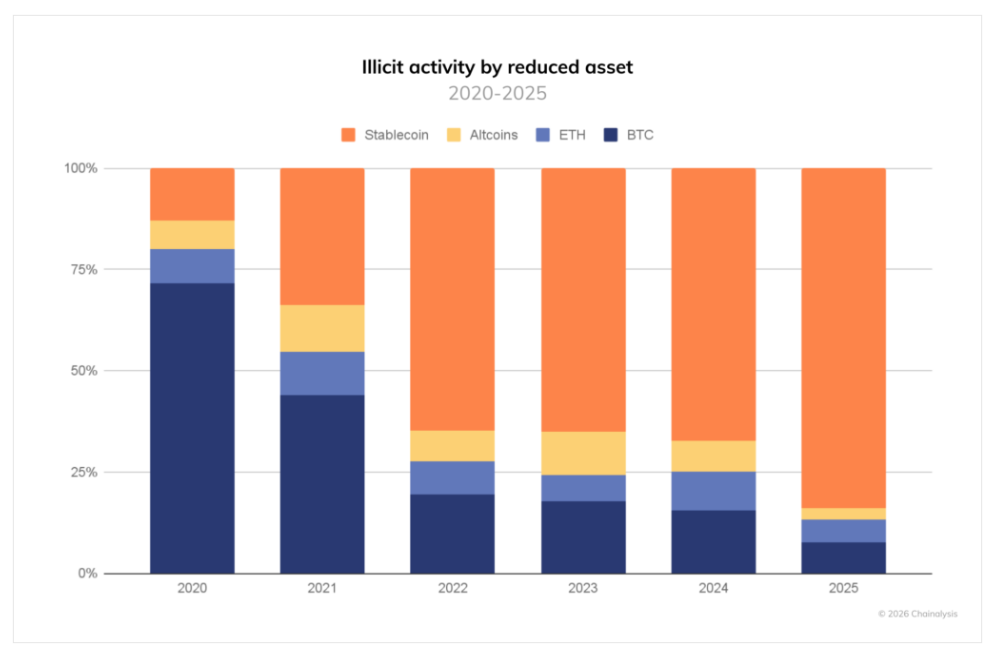
Source: Chainalysis — In 2025, illegal virtual asset transactions reached $154 billion, with stablecoins accounting for 84%
Additionally, according to a report released in mid-February by blockchain analysis firm TRM Labs, illicit entities received a total of $141 billion in stablecoins in 2025, setting a five-year high. The report notes that last year, overall stablecoin activity repeatedly exceeded $1 trillion per month, with 86% related to sanctions.
The report emphasizes that malicious actors often hide their funds using cross-chain technology, decentralized exchanges, and OTC brokers. FATF highlights that peer-to-peer transfers through non-custodial wallets are a critical vulnerability, as these transactions occur in environments lacking anti-money laundering controls, making it difficult for regulators to track geographic locations and beneficiaries.
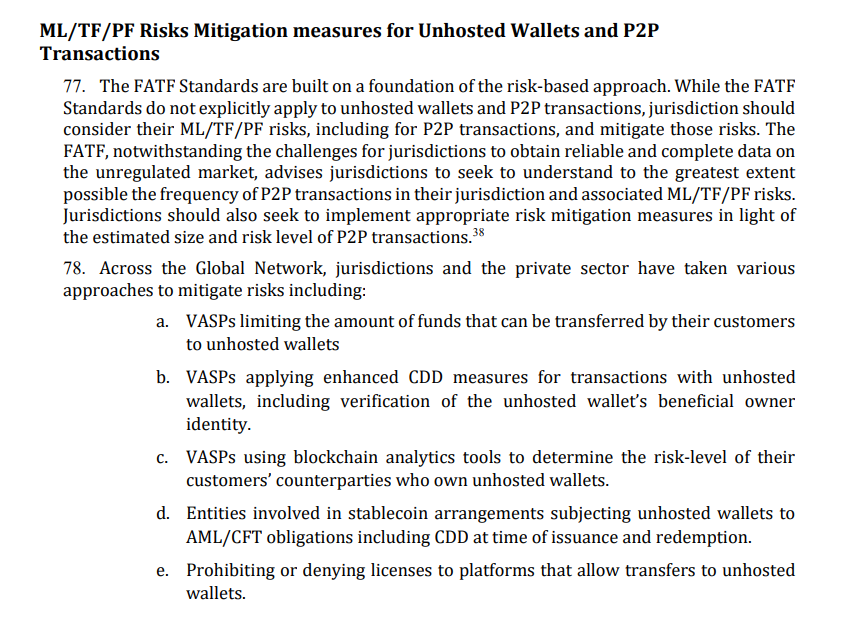
Source: FATF report — Peer-to-peer virtual asset transfers via non-custodial wallets are a key vulnerability
Stablecoin Market Cap Surpasses $300 Billion, Urgent Need for Regulation
It’s important to note that FATF does not call for banning stablecoins outright but strongly urges countries to impose anti-money laundering obligations on stablecoin issuers and intermediaries.
FATF recommends that stablecoin issuers utilize smart contract control features to establish whitelists and blacklists to restrict certain wallet transactions. Issuers should have the technical capability to intercept, freeze, and destroy suspicious stablecoins in secondary markets. To address cross-border operational challenges, FATF encourages countries to establish international regulatory bodies to enhance information sharing and joint oversight.
Currently, the global stablecoin market value has exceeded $300 billion. As adoption accelerates and integration with traditional finance deepens, FATF believes that regulators worldwide must act swiftly and implement blockchain analysis tools to close regulatory and compliance gaps.
Further Reading:
Preparing for Crypto Legislation! E.SUN Bank: Banking sector to adopt three-tier financial models, not missing out on stablecoins and tokenization
Conflict impacts Gaza banks! Trump’s Peace Commission plans to use US dollar stablecoins to promote digital transactions
Disclaimer: The information on this page may come from third parties and does not represent the views or opinions of Gate. The content displayed on this page is for reference only and does not constitute any financial, investment, or legal advice. Gate does not guarantee the accuracy or completeness of the information and shall not be liable for any losses arising from the use of this information. Virtual asset investments carry high risks and are subject to significant price volatility. You may lose all of your invested principal. Please fully understand the relevant risks and make prudent decisions based on your own financial situation and risk tolerance. For details, please refer to
Disclaimer.
Related Articles
Xinda Futures: Rising Energy Prices Constrain Rate Expectations, Gold Under Short-Term Pressure
Xinda Futures research indicates that gold price movements are influenced by rising energy prices and interest rate expectations. The Middle East conflict has kept crude oil at elevated levels, intensifying inflation concerns in the market and suppressing gold prices. The market expects the Federal Reserve to maintain interest rates unchanged, but Powell's assessment will impact subsequent policy decisions.
GateNews57m ago
Sky Co-founder Rune's Long Position in Crude Oil Turned Profitable, Overall Position Value Rose to $11.55 Million
On March 22, after Trump issued a "48-hour ultimatum," crude oil prices rose. Sky founder Rune's multiple leveraged positions were profitable, with a structure including a 20x leveraged WTI crude oil long position with unrealized gains of approximately $155,000, a 7x leveraged Brent crude oil long position with unrealized gains of approximately $130,000, and total position value reaching approximately $11.55 million.
GateNews1h ago
Tom Lee: Maintains S&P 500 Year-End Target of 7700, War Historically Often Signals Buying Opportunity
Ethereum Treasury Company Chairman Tom Lee maintained his year-end S&P 500 target of 7700 in an interview, viewing this as a conservative estimate. Despite the short-term impact of the war, it could benefit the U.S. economy in the long term, and the market may shift from crisis to opportunity. He pointed out that the market has already adjusted, and investors have completed their de-risking.
GateNews1h ago
Iran Bombs Israel "Nuclear Facility Surroundings" for First Time, No Nuclear Leakage So Far, But Terrorist Retaliation Cycle May Escalate
Iran launched a missile attack targeting around the Israeli nuclear research center late on March 21, causing at least 7 people to be seriously injured and 64 hospitalized. Israel's missile defense system was unable to fully intercept the missiles, worsening the tense situation. This attack is seen as retaliation for Israel's bombing of Iranian nuclear facilities, and geopolitical tensions continue to rise. The United Nations has stated that there are currently no radiation anomalies, but the risk still exists.
動區BlockTempo1h ago
Trump Issues Ultimatum: Iran Must Open Strait of Hormuz Within 48 Hours "Or We'll Bomb Power Plants," Bitcoin Plummets to 68,000
Trump issued a 48-hour ultimatum this morning (22nd) demanding Iran fully open the Strait of Hormuz, otherwise the U.S. military will destroy Iran's power plants; following the announcement, Bitcoin plummeted rapidly to $68,000, with the Fear and Greed Index dropping to 9, indicating extreme market panic.
(Background: Iran launched medium-range missiles at U.S. and British bases, missing but with a range of 4,000 kilometers, "double what intelligence estimated")
(Context: Lai Ching-te approved: Nuclear Plants 2 and 3 "have conditions for restart," Taiwan's power shortage in the AI era cannot be sustained)
Contents of this article
Toggle
Middle East conflict has been burning for over 4 weeks
Bitcoin crashes to $68,000, liquidations of $236 million
48-hour countdown, market awaits three answers
U.S. President Trump posted on his social media platform Truth Social at 7:44 AM this morning (22nd)
動區BlockTempo2h ago
Citigroup Slashes Bitcoin and Ethereum 12-Month Price Targets, Citing Stalled U.S. Crypto Legislation Weighing on Upside Catalysts
Citigroup has lowered its target prices for Bitcoin and Ethereum, indicating a cautious outlook on the medium-term prospects of the crypto market. The Bitcoin target price has been reduced from $143,000 to $112,000, while Ethereum's has been lowered from $4,304 to $3,175, mainly due to slow progress in U.S. cryptocurrency legislation. Although there is still room for upward movement over the next year, the market may remain volatile in the short term, with Ethereum's valuation becoming more reliant on fundamentals.
区块客4h ago


