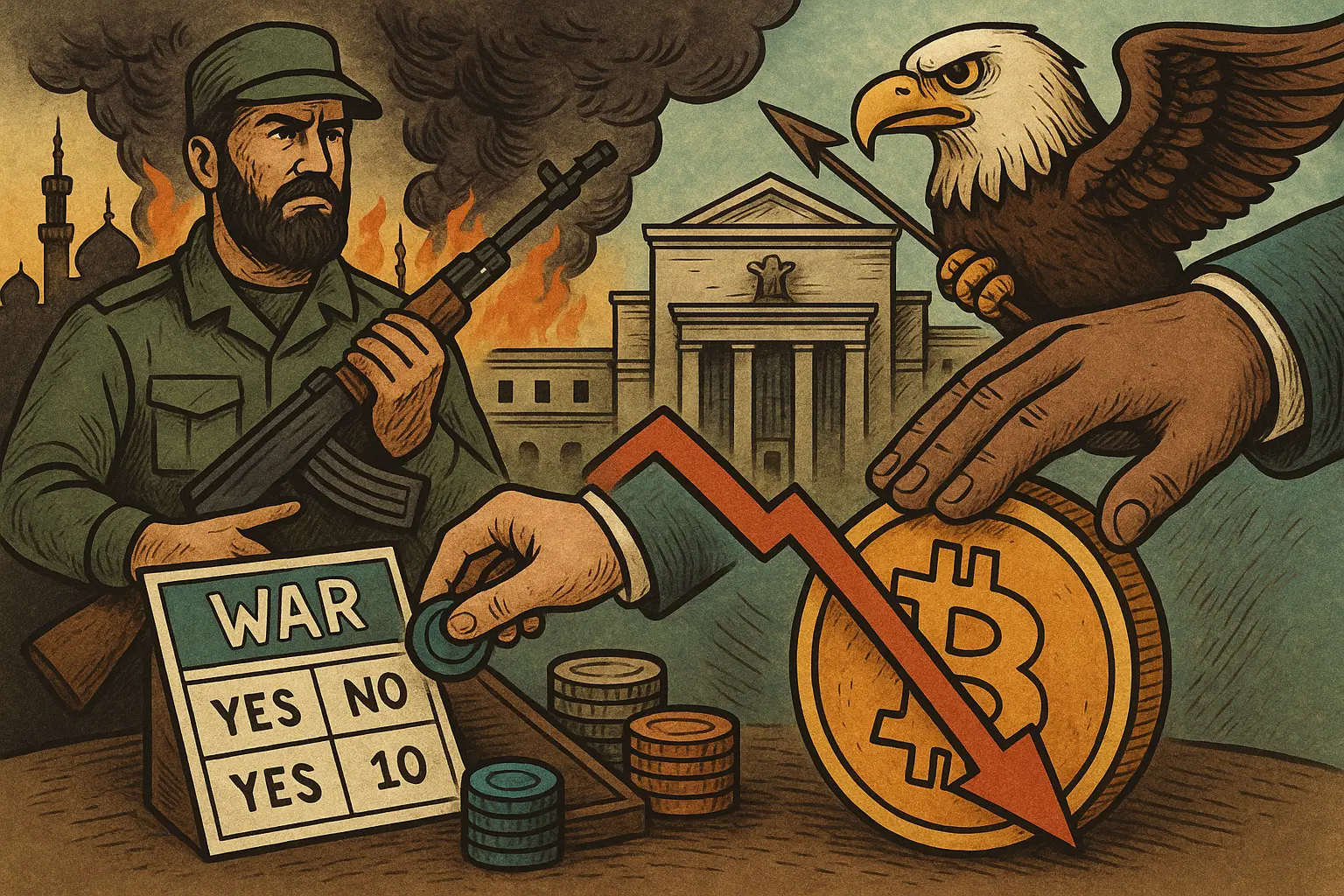
The latest data from the cryptocurrency prediction market Polymarket shows that the probability of a ceasefire between the U.S. and Iran before March 31 is only 7%. Meanwhile, the Federal Reserve on Wednesday kept interest rates steady at 3.50%-3.75% and raised the 2026 inflation expectation from 2.4% to 2.7%. Influenced by the Fed’s meeting results, Bitcoin fell nearly 4% to $71,017.
Polymarket and Good Judgment Consensus Predictions
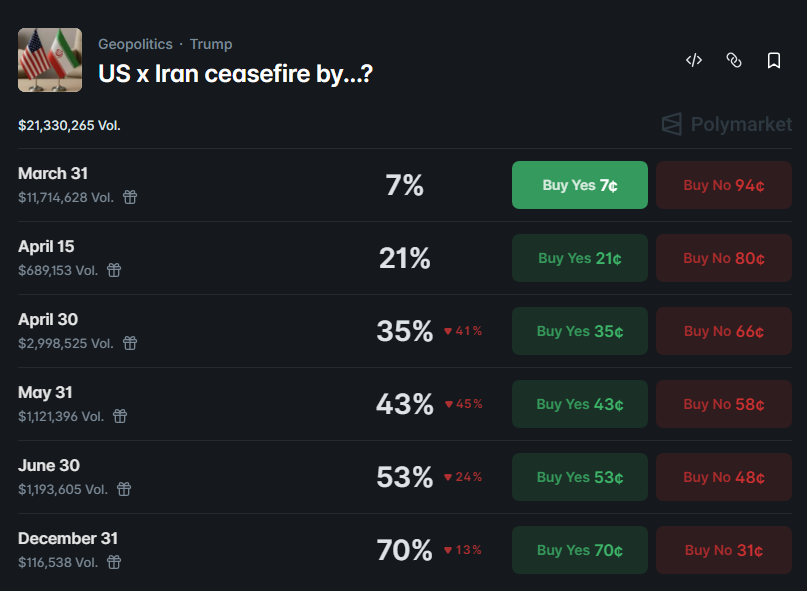
(Source: Polymarket)
Since the outbreak of the U.S.-Iran conflict on February 28, 2026, Polymarket has recorded over $21.3 million in related market trading volume. The evolution of ceasefire probability data clearly reflects market sentiment:
Ceasefire before March 31: 7% (significantly down from peak)
Ceasefire before April 30: 35% (down 41 percentage points from peak)
Ceasefire before June 30: 53%
The latest assessment from Good Judgment’s “Superforecasters” network also indicates an extension:
Ceasefire before March 26: 2% (sharp decline)
Ceasefire before May 15: 43% (up 10 percentage points within a week)
Ceasefire between April 17 and May 14: 30% (up 7 percentage points)
Iranian Foreign Minister Abdollahian Araghchi stated in an interview with CBS on March 15 that Tehran “has never demanded a ceasefire.” Before this official stance shifted, market prediction data suggests investors should prepare for a prolonged standoff.
The Fed’s Dilemma: Oil Prices, Inflation, and Rate Cuts in a Triangular Conflict
Fed Chair Jerome Powell admitted after this week’s FOMC meeting that the committee faces a real policy dilemma: inflation risks theoretically call for rate hikes, while a weak labor market demands rate cuts. He raised the 2026 inflation expectation from 2.4% to 2.7% and noted that core PCE inflation is currently at 3.0%, with tariffs contributing about 0.5 to 0.75 percentage points, and the impact of rising energy prices “undoubtedly” reflected in the latest forecasts.
Notably, some FOMC members proposed to completely eliminate economic projections at this meeting due to the excessive uncertainty introduced by Middle East conflicts. While Powell rejected direct comparisons of the current situation to stagflation in the 1970s, he acknowledged that “five consecutive years of inflation above target” will make maintaining inflation expectations more difficult.
Influenced by Fed decisions, traders currently expect less than one rate cut by 2026, with the U.S. 2-year Treasury yield rising 6 basis points to 3.73%.
Market Chain Reactions: From Oil to Bitcoin
Multiple intersecting events have triggered broad market volatility:
Brent Crude Oil: surged to $108.78 per barrel on March 18, up about $38 from the same period last year; IEA reports that Middle East turmoil reduced global oil supply by approximately 8 million barrels per day in March.
Bitcoin: down nearly 4% to $71,017, continuing the sell-off after the FOMC meeting.
Nasdaq: closed down 1.5%, at the day’s low.
Nikkei 225 (Japan): down 2.80% (high dependence on imports for energy).
KOSPI (South Korea): down 2.95% (also highly reliant on imported energy).
FAQs
How does Polymarket calculate ceasefire probabilities, and how reliable are these predictions?
Polymarket is a decentralized prediction market where probability figures reflect the collective betting distribution of market participants. In theory, when the market is sufficiently deep and liquid, prediction outcomes can aggregate dispersed information and often outperform traditional polls or institutional forecasts. However, for high-uncertainty geopolitical events, market probabilities are limited by information disclosure, liquidity, and participant structure, so they should be cross-checked with other forecasting sources like Good Judgment.
Why is the Fed choosing to hold rates steady during the Middle East conflict instead of acting?
Powell’s core stance is to remain cautious until clearer signals emerge from inflation and labor market data. He indicated that the Fed will “gather a lot of information” over the next six weeks before the next FOMC meeting, implying subsequent decisions will be more definitive. Some FOMC members proposed to fully cancel economic projections this time due to the high uncertainty introduced by the conflict, reflecting a consensus that premature action could pose greater policy risks.
If signals of a ceasefire between the U.S. and Iran improve, will Bitcoin rebound quickly?
Analysts suggest that clear ceasefire signals could rapidly ease macro pressures from high oil prices and persistent inflation, potentially reigniting rate cut expectations. This would serve as a positive catalyst for risk assets, including Bitcoin. Market prediction data itself is a leading indicator—when the probability of ceasefire rises sharply from current lows, market sentiment may reverse faster than actual ceasefire agreements are signed.
Disclaimer: The information on this page may come from third parties and does not represent the views or opinions of Gate. The content displayed on this page is for reference only and does not constitute any financial, investment, or legal advice. Gate does not guarantee the accuracy or completeness of the information and shall not be liable for any losses arising from the use of this information. Virtual asset investments carry high risks and are subject to significant price volatility. You may lose all of your invested principal. Please fully understand the relevant risks and make prudent decisions based on your own financial situation and risk tolerance. For details, please refer to
Disclaimer.


