
The SEC submits token classification guidelines to OIRA to clarify the scope of securities law application and accelerates institutionalized regulatory layout amid market structure legislative stagnation.
SEC issues interpretive guidance attempting to clarify legal positioning of crypto assets
The U.S. Securities and Exchange Commission (SEC) recently submitted a new regulatory interpretive document to the White House Office of Management and Budget (OIRA), titled “Commission Interpretation on the Application of Federal Securities Laws to Certain Types of Crypto Assets and Related Transactions.” This document aims to explain how federal securities laws apply to different types of crypto assets and trading scenarios.
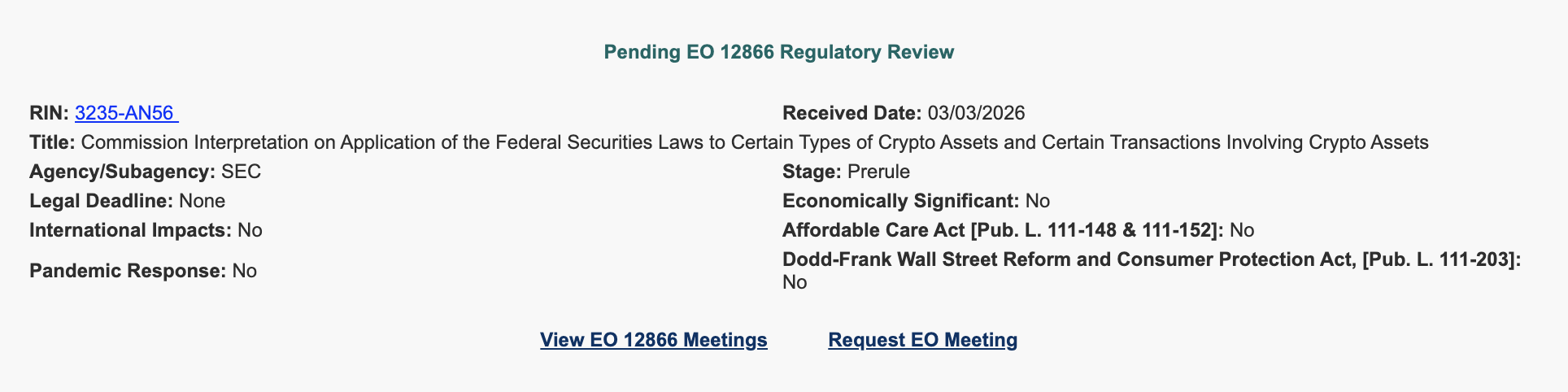
Image source: SEC SEC recently submitted a new regulatory interpretive document to OIRA
The guidance is in the inter-agency review stage and is a regulatory interpretive document. It differs from formal rulemaking. Interpretive documents avoid public comment periods or lengthy legislative procedures. Interpretations issued at the SEC commission level carry significant policy guidance authority.
Market observers point out that the core purpose of this document is to establish a “Token Taxonomy.” This framework will systematically classify different types of crypto assets and determine which should be considered securities and fall under SEC jurisdiction, and which assets are subject to other regulatory frameworks.
Token taxonomy as the core of regulation, impacting industry operations
SEC Chair Paul Atkins has repeatedly emphasized that establishing a clear token taxonomy is key to resolving regulatory disputes in the crypto industry. Through classification, regulators can better define the legal nature of different tokens. For example, determining which are investment contract assets, which are utility tokens, or whether assets fall under other digital asset categories.
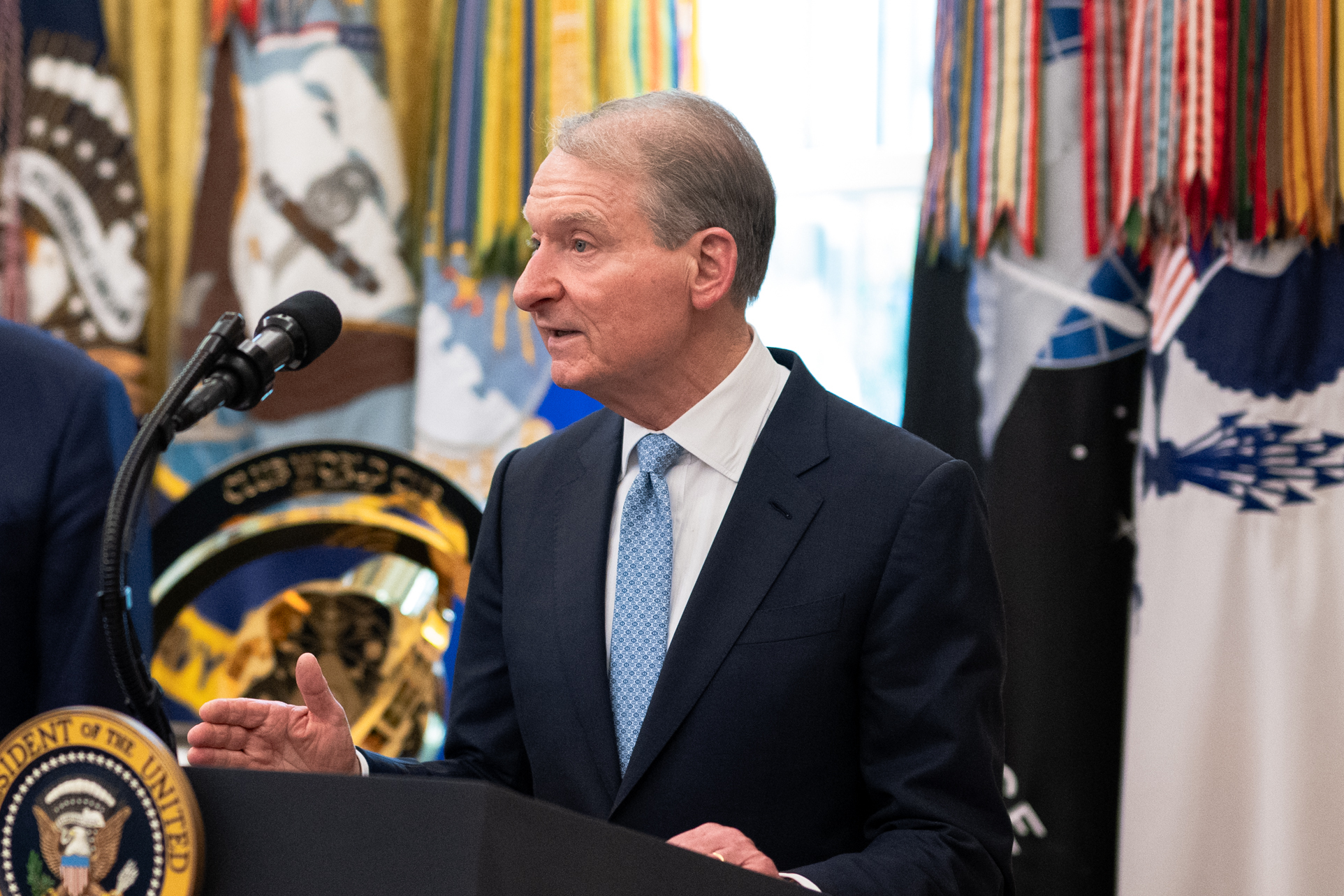
Image source: CoinMarketCap SEC Chair Paul Atkins
Once the classification framework is established, regulatory requirements for crypto companies regarding registration, disclosure, product issuance, and investor protection will become clearer. The operational models and compliance strategies of exchanges, issuers, and investment platforms will be directly affected.
Analysis indicates that while SEC’s interpretive guidance does not change the law itself, it will serve as an important basis for enforcement. Compared to informal explanations issued by agency staff in the past, commission-level interpretations are generally seen as more authoritative and are more likely to be cited in enforcement and judicial proceedings.
Market structure legislation stagnates, regulators accelerate action
The timing of SEC’s guidance coincides with legislative deadlock in Congress over the Digital Asset Market Structure Act. The bill was originally intended to clearly delineate the regulatory authority between the SEC and the Commodity Futures Trading Commission (CFTC) in the digital asset market. During Senate deliberations, the bill was delayed due to disputes over stablecoin yield mechanisms involving banking and crypto industry stakeholders.
In the absence of legislative progress, regulators are beginning to issue guidance based on existing legal frameworks to fill regulatory gaps. The White House has recently convened multiple meetings with banking and crypto industry representatives to seek consensus on market structure and regulatory authority issues.
Meanwhile, the CFTC has also submitted a regulatory proposal related to prediction markets to OIRA. This indicates that both major financial regulators are simultaneously strengthening their policy layout for the digital asset market.
Regulatory authority and market order, digital asset regulation enters a new phase
Currently, the SEC has three commissioners, while the CFTC has only one. Both agencies were originally designed as five-member bipartisan commissions. The current leadership is mostly composed of Republican members, with Democratic representatives yet to be appointed. The public is paying close attention to how future personnel arrangements will influence regulatory directions.
On the other hand, there are still disputes over jurisdictional boundaries in certain market sectors between the SEC and CFTC. For example, CFTC Chair Michael Selig recently stated that prediction markets should be fully regulated by the CFTC and emphasized its “exclusive jurisdiction” over related markets.
As the global digital asset market rapidly develops, U.S. regulators are gradually building a more complete legal and regulatory framework. The SEC’s push for a token classification framework is a significant step toward institutionalizing crypto regulation, which could have a profound impact on global regulatory trends in the crypto space.
Disclaimer: The information on this page may come from third parties and does not represent the views or opinions of Gate. The content displayed on this page is for reference only and does not constitute any financial, investment, or legal advice. Gate does not guarantee the accuracy or completeness of the information and shall not be liable for any losses arising from the use of this information. Virtual asset investments carry high risks and are subject to significant price volatility. You may lose all of your invested principal. Please fully understand the relevant risks and make prudent decisions based on your own financial situation and risk tolerance. For details, please refer to
Disclaimer.
Related Articles
Bloomberg: Only 6.5% of U.S. Taxpayers Reported Crypto Sales Despite 12-21% Ownership Rate
A study shows that only 6.5% of U.S. taxpayers reported cryptocurrency sales from 2013 to 2021, despite surveys indicating 12% to 21% of adults owned crypto. Younger, lower-income investors favored meme tokens, with significant trading differences from traditional stocks.
GateNews31m ago
Encourage innovation! U.S. judges ban Arizona from regulating prediction markets, pausing the prosecution of Kalshi
A U.S. federal district court ruled that Arizona is barred from bringing charges against prediction market platform Kalshi under gambling laws, finding that the Federal Commodity Futures Trading Commission has exclusive jurisdiction. The ruling affects the boundary between state and federal authority in regulating financial markets. Kalshi, meanwhile, insists that its business falls under financial products rather than traditional gambling. Rulings by different states on prediction markets have varied, and the Trump family has also voiced support for prediction markets.
CryptoCity50m ago
Fed Chair Nominee Kevin Warsh Discloses Crypto Investments Ahead of Senate Hearing
Kevin Warsh, nominated for Federal Reserve Chair, reported investments in over 20 digital asset companies. His portfolio includes DeFi platforms, blockchain networks, and Web3 projects. The Senate Banking Committee may advance his nomination, raising potential conflict of interest concerns.
GateNews1h ago
Russia's Central Bank to Require KYC for All Crypto Traders and Overseas Holdings Declaration by July
Russia's central bank will require cryptocurrency traders to verify their identities and declare overseas holdings by July 2026. Transfers must go through official channels, with plans for a digital ruble to support transparency and compliance.
GateNews1h ago
Can bypass Taiwan Financial Supervisory Commission (FSC) rules on buying crypto with credit cards be possible? OdinTech launches the Wallet Pro service for buying crypto with U.S. debit cards
OwlPay and Wallet Pro services launched by Odin Ding use stablecoin technology to enable B2B cross-border payments, and they partner with international payment giants to showcase their ambitions to expand in the fintech sector. By operating from overseas, Odin Ding bypasses Taiwan’s regulatory restrictions, offering fast virtual-asset trading. At the same time, in light of the newly issued Virtual Asset Services Act, it is expected to become a reference template for other foreign-funded companies entering the Taiwan market.
CryptoCity1h ago
Encourage innovation! A U.S. judge bans Arizona’s regulation of prediction markets and suspends the prosecution of Kalshi
A U.S. federal district court ruled that Arizona may not rely on its gambling law to prosecute the prediction market platform Kalshi, finding that the U.S. Commodity Futures Trading Commission has exclusive jurisdiction. The ruling affects the line between state and federal authority in financial market regulation, while Kalshi maintains that its business is a financial product rather than traditional gambling. Decisions by states on prediction markets have differed, and the Trump family has also expressed support for prediction markets.
CryptoCity3h ago


