Market Insider Trading Controversy Escalates Again—Following the Maduro Incident, Israeli Authorities Officially Charge a Civilian and a Reserve Military Member, Accusing Them of Profiting from Using Confidential Military Intelligence to Bet on Polymarket. The Suspicious Accounts Predicted Six Israeli Military Operations Correctly, Netting Over $150,000 in Profits. This article is sourced from Odaily’s report “Israeli Military, Catching Spies on Polymarket,” translated and edited by Dongqu.
(Background recap: Data shows prediction markets “spoiled” Maduro’s downfall 10 million dollars in advance)
(Additional context: U.S. lawmakers propose legislation to ban government employees from insider trading on prediction markets! Polymarket suspected of leaking plans to arrest Maduro)
Table of Contents
- Israel charges two suspects, accusing them of betting using military secrets
- Suspect account “Rundeep”: Six military predictions all correct
- The double-edged sword of prediction markets: a convenient “intelligence monetization” channel
The information advantage brought by insider knowledge has always been a controversial issue on prediction markets like Polymarket.
Previously, during the U.S. arrest of Venezuelan President Maduro, abnormal fluctuations in the odds of related contracts on Polymarket appeared in advance (see “When War Is Settled Before News: How Prediction Markets Price Maduro’s Arrest 6 Days Early”), suggesting possible insider manipulation. If that incident could be dismissed as a “pizza index” fluctuation, this time, someone on Polymarket has definitively used insider information to bet—this has been thoroughly confirmed.
Israel charges two suspects, accusing them of betting using military secrets
On February 12, The Jerusalem Post reported that the Tel Aviv District Court formally charged a civilian and an IDF reserve soldier, accusing them of using classified military intelligence to profit from bets on Polymarket. The court further stated on Thursday that Israeli authorities consider this conduct a serious operational security risk during wartime.
According to a publicly approved statement from prosecutors, the suspects were apprehended during joint operations involving the Shin Bet, the Defense Ministry’s security agencies, and the Israeli police. Investigators suspect that some reserve soldiers are leveraging their access to confidential information to place bets on military operation schedules for profit.
Following these investigations, prosecutors announced they have evidence of the suspects’ illegal activities and have formally charged them with “serious security crimes,” bribery, and obstruction of justice. They also requested the court extend the suspects’ detention until the conclusion of the trial.
Beyond the publicly available details, further case information remains restricted by law, including the identities of the accused, specific betting targets, and the channels through which information was transmitted.
Suspect account “Rundeep”: Six military predictions all correct
Although the true identity and account of the insider remain unconfirmed, the X community has already identified a suspicious account pattern on Polymarket. The Jerusalem Post also included screenshots of the account’s profits in their report.
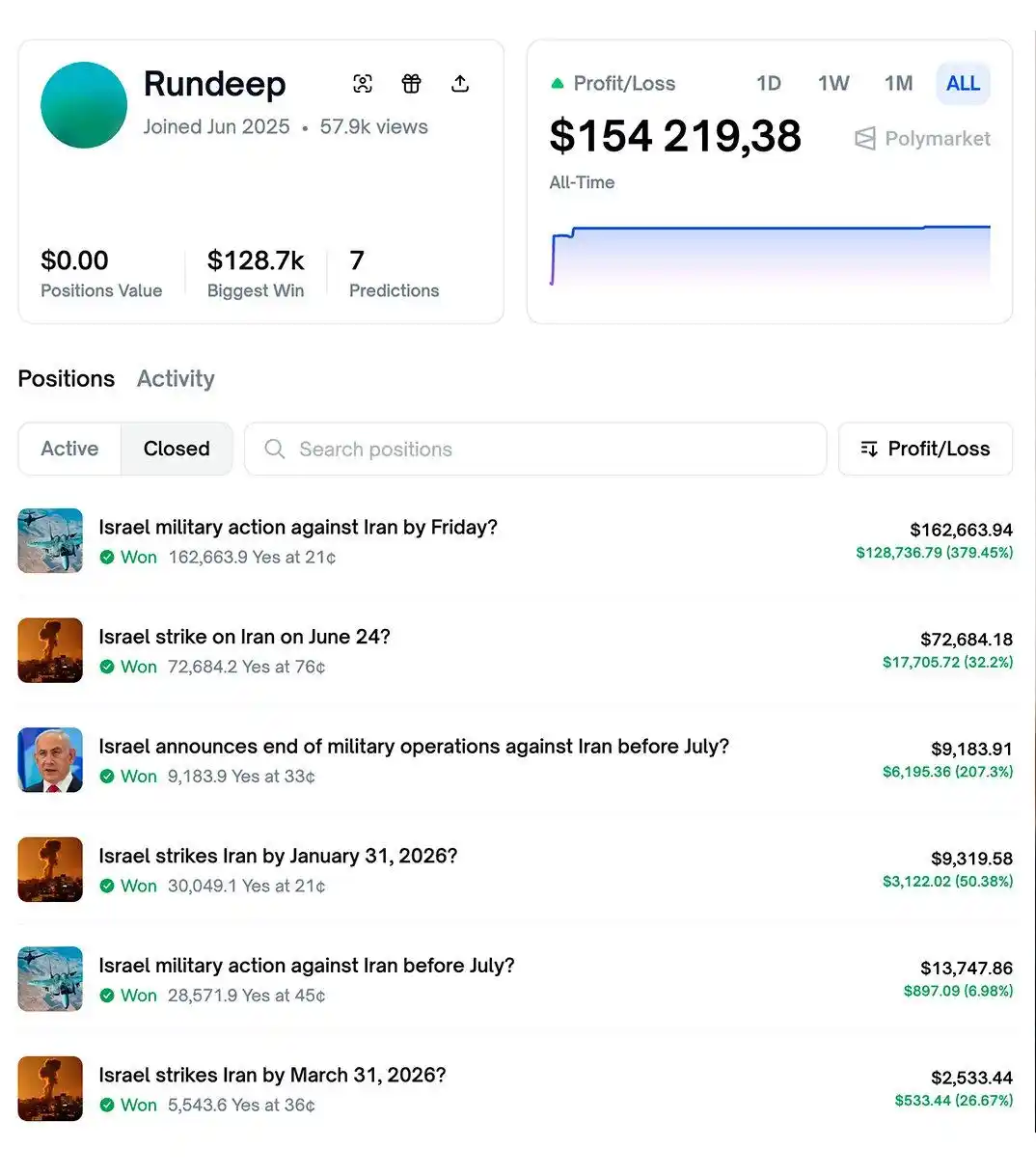
As shown above, the user named Rundeep joined Polymarket in June 2025 and subsequently achieved a 100% success rate across six predictions related to Israeli military actions, five of which involved low probabilities below 50%, ultimately earning over $150,000 in profit.

Interestingly, according to Odaily Planet Daily, besides these “six wins,” Rundeep had one failed prediction, which was unrelated to Israel but concerned whether the U.S. would launch an operation against Iran before Saturday, June 21, 2025—indicating that even allied intelligence isn’t infallible.
The double-edged sword of prediction markets: a convenient “intelligence monetization” channel
Because Polymarket is open and permissionless, anyone can freely place bets on the platform. This objectively provides those with an information advantage a more convenient way to monetize intelligence—driven by profit motives, individuals with asymmetric information often find it hard to resist temptation, leading to insider betting.
If such incidents occur in sports or entertainment, the impact might be manageable, but when the scenario shifts to politics or war—highly sensitive areas—the chain reactions triggered by insider betting could be truly chilling.
For example, in this case, if opponents used insider information on Polymarket to anticipate military actions, it could significantly influence subsequent developments. While many may not empathize with Israel, such events could happen in any country.
In traditional betting, public affairs like political elections, legislative outcomes, or military operations are usually subject to regulation. Whether prediction markets will face similar regulatory constraints in the future remains to be seen, likely involving a lengthy regulatory struggle.
Original link

Disclaimer: The information on this page may come from third parties and does not represent the views or opinions of Gate. The content displayed on this page is for reference only and does not constitute any financial, investment, or legal advice. Gate does not guarantee the accuracy or completeness of the information and shall not be liable for any losses arising from the use of this information. Virtual asset investments carry high risks and are subject to significant price volatility. You may lose all of your invested principal. Please fully understand the relevant risks and make prudent decisions based on your own financial situation and risk tolerance. For details, please refer to
Disclaimer.
Related Articles
Hey Anon Announces Launch of “Pandora” Prediction Market on Ethereum
Hey Anon launches Pandora, a decentralized AI-driven prediction market on Ethereum, empowering users to create transparent markets without central control. The platform features unique AI consensus mechanisms and aims to innovate the prediction market landscape.
CoinDesk1h ago
Polymarket Insiders Place Big Bets on U.S.-Iran Ceasefire Deal
A group of popular wallets on Polymarket, suspected of insider activity, is betting on a US-Iran ceasefire by March 31. This coincides with Trump's claims of effective talks with Iran, which Tehran rejects. On-chain data indicates these wallets previously profited from significant bets around US-Iran tensions.
TapChiBitcoin2h ago
Polymarket "Clarity Act Signs into Law by 2026" probability report 54%, down 11% in 24 hours
On March 26, due to disagreements within the industry over a compromise proposal on the Clarity Act stablecoin yield provision, Polymarket's probability of it becoming law dropped to 54%. A certain CEX expressed dissatisfaction with the compromise text, industry opinions remain divided, and the stock prices of stablecoin issuers have fallen as a result. White House advisors indicated they will address this matter, with the final text expected to be released by the end of this week.
GateNews2h ago
Iran Seeks Legislation to Impose Transit Fees on Ships Passing Through the Strait of Hormuz
The head of Iran's parliamentary civil committee stated that Iran plans to pass legislation to impose transit fees on vessels in the Strait of Hormuz to maintain sovereignty and generate revenue for the country. The bill has been drafted and will be refined before submission to parliament. Previously, Iran has already begun collecting transit fees from some merchant vessels, demonstrating its control over the waterway.
BlockBeatNews3h ago
Polymarket Suspected Insider Trading: 6 "Mystery Wallets" Bet on US-Iran Ceasefire
Recently, six wallets on Polymarket precisely built positions before the U.S. attack on Iran and profited $1.2 million, then continued betting on Iranian nuclear facilities, and later coordinated a $100,000 bet predicting a U.S.-Iran ceasefire. This series of transactions has raised market concerns about information advantages and highlighted a trust crisis in prediction markets. Changes in market participant behavior reflect worries about insider trading, and the conflict between transparency and anonymity makes it difficult to trace responsibility.
MarketWhisper4h ago


