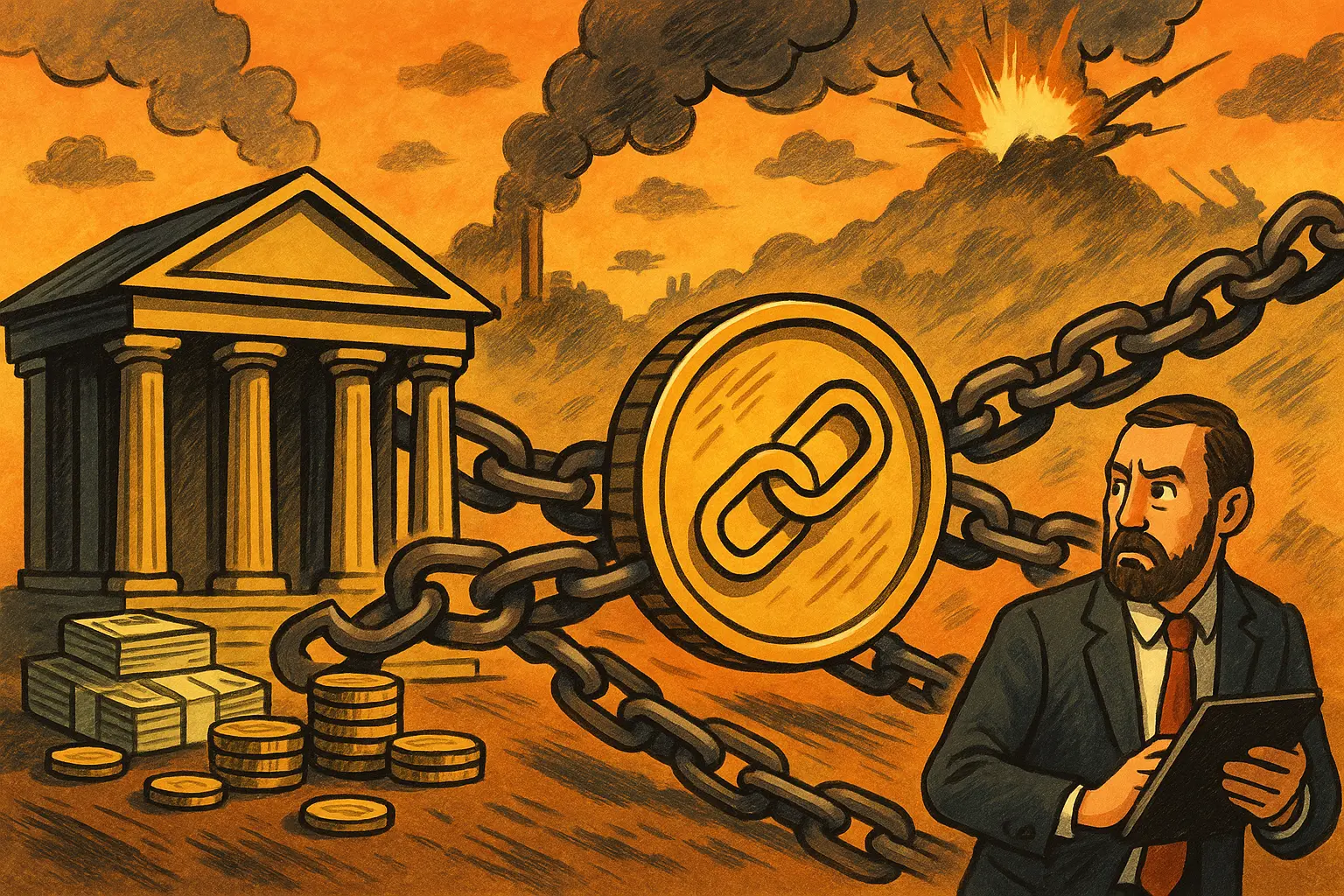
Bitwise Chief Investment Officer Matt Hougan stated in an article titled “A Weekend That Changed Finance” that during the U.S.-Iran strikes, while major global exchanges were closed, Hyperliquid became the center for trading real-world assets like crude oil and tokenized gold. He significantly revised his timeline for traditional finance (TradFi) shifting onto the blockchain.
“A Weekend That Changed Finance”: The Timing Gap Revealed by the Iran Crisis
The U.S.-Iran actions began around 3:30 a.m. UTC on Saturday, coinciding with the full closure of stock exchanges in the U.S., Europe, and Asia. During this window when traditional financial systems were completely halted, crypto platforms like Hyperliquid became the only channels for global investors to manage risk.
Hougan pointed out that over the weekend, Hyperliquid’s trading volume exceeded $11.5 billion; Tether’s tokenized gold product Tether Gold (XAUt) saw 24-hour trading surge past $300 million; and trading volumes in prediction markets like Kalshi and Polymarket also increased.
More symbolically, Bloomberg cited Hyperliquid crude oil contracts as the “most relevant price” in their coverage of the explosion event—mainstream financial media are beginning to view on-chain derivatives as more timely price discovery tools than traditional markets.
Hougan said he previously expected it would take 5 to 10 years for TradFi to move onto the blockchain, but this weekend changed his mind: “This weekend proved I was wrong. I now believe it will happen much faster than I imagined.” He added that blockchain’s 24/7 trading channels make “stock exchanges and T+1 settlement seem outdated.”
Institutions Have No Choice: NYSE’s 24/7 Strategy
Hougan noted that hedge funds, banks, and other institutional investors seeking “competitive trading” currently have no choice but to set up stablecoin wallets and learn how to trade on platforms like Hyperliquid. This indicates that TradFi institutions’ participation in on-chain finance is no longer just a strategic choice but a defensive move driven by crisis.
The New York Stock Exchange (NYSE) and its parent company Intercontinental Exchange (ICE) announced in January this year plans to implement 24/7 trading and real-time settlement for stocks and ETFs via blockchain trading systems supporting multiple chains and custody functions. However, the launch date, underlying blockchain selection, and permission architecture have not yet been disclosed.
Key Data Comparing On-Chain Finance and TradFi
- Hyperliquid weekend trading volume: Over $11.5 billion (Saturday and Sunday combined)
- Tether Gold (XAUt) 24-hour trading volume: Surged past $300 million
- Event timing significance: Strike occurred at 3:30 a.m. UTC, during global market closures
- Bloomberg citation: Used Hyperliquid crude oil contracts as the most relevant oil price benchmark during the crisis
- NYSE/ICE plans: Announced a 24/7 tokenized trading platform, but core technical details remain undisclosed
Frequently Asked Questions
Why is the “weekend timing” of the US-Iran conflict particularly significant for TradFi’s on-chain transition?
Traditional stock and commodity markets are closed on weekends. When major geopolitical events occur during this period, investors cannot adjust their positions through conventional channels. Crypto platforms operate 24/7, filling this liquidity gap. This weekend’s events serve as the largest “stress test” to date, directly validating the practical utility of on-chain finance during market closures.
Does the trading of crude oil and tokenized gold on Hyperliquid represent a true shift of TradFi onto the blockchain?
Hyperliquid’s trading involves derivatives of oil and gold (such as tokenized gold XAUt), not physical assets directly. Currently, this mainly serves as a supplementary channel for institutions when traditional markets are inaccessible, rather than a complete replacement. True TradFi on-chain transfer requires large-scale tokenization of stocks, bonds, and other traditional assets, along with infrastructure standardization—this still takes time.
What potential impact could NYSE’s 24/7 tokenized trading plans have on the existing crypto market?
If NYSE launches a 24/7 tokenized stock trading platform, it could significantly boost liquidity for traditional assets on-chain and challenge the market position of existing decentralized exchanges like Hyperliquid. The onboarding of substantial institutional capital onto the blockchain could deepen overall market liquidity, marking a key milestone in the mainstream adoption of crypto.
Disclaimer: The information on this page may come from third parties and does not represent the views or opinions of Gate. The content displayed on this page is for reference only and does not constitute any financial, investment, or legal advice. Gate does not guarantee the accuracy or completeness of the information and shall not be liable for any losses arising from the use of this information. Virtual asset investments carry high risks and are subject to significant price volatility. You may lose all of your invested principal. Please fully understand the relevant risks and make prudent decisions based on your own financial situation and risk tolerance. For details, please refer to
Disclaimer.
Related Articles
TAO Price Explodes 140% in 6 Weeks, But Bittensor’s Social Data Says the Rally Is Just Getting Started
Bittensor has been one of the hardest‑charging assets in crypto in recent weeks. The TAO price pumped 140% in six weeks, and climbed 105% since March 8 alone. The token now has a $2.9 billion market cap, which means it’s ranking 26 overall, as capital rotates toward decentralized machine
CaptainAltcoin23m ago
TAO surges 140%, low retail FOMO turns into a bullish signal
Bittensor (TAO) recently surged by 140%, reaching a high of $377.8, mainly driven by capital rotation in AI-themed investments and supported by solid fundamentals. Although community discussion volume has increased, retail sentiment remains relatively calm, indicating potential upside. The total staked amount on TAO's subnet has risen from $74,400 to over $620 million, reflecting investor confidence in its future.
MarketWhisper23m ago
Is there hidden risk behind Bitcoin holding steady at $70,000? Two major indicators weaken, reducing upward momentum.
Amid increasing geopolitical conflicts and macroeconomic uncertainties, Bitcoin remains steady at $70,000, demonstrating resilience. However, the decline in CEX premiums and slowing ETF capital flows indicate that institutional investors are becoming more cautious, and the market may enter a period of consolidation.
GateNews29m ago
Nick Carter: Bitcoin's quantum resistance lags behind; Ethereum may lead a bullish divergence
Nick Carter warns that Bitcoin is lagging in quantum resistance, emphasizing that its use of elliptic curve cryptography will become outdated and recommending a redesign of replaceable encryption technologies. In contrast, Ethereum has developed a post-quantum upgrade roadmap through 2029 and considers it a top priority. Google also predicts that quantum threats will become a reality before 2029, posing a risk to blockchain security.
MarketWhisper32m ago
Crypto Fear & Greed Index drops to 10, market "fear" sentiment rises
BlockBeats News, March 26 — According to Alternative data, today’s cryptocurrency Fear and Greed Index is 10 (yesterday was 14), indicating increased market "fear" sentiment.
Note: The Fear and Greed Index threshold is 0-100, composed of indicators: volatility (25%), market trading volume (25%), social media activity (15%), market surveys (15%), Bitcoin’s proportion in the overall market (10%), and Google trending searches analysis (10%).
BlockBeatNews34m ago
Pi coin's 7-month low-volatility period has ended; an 108% rebound in volatility signals a major market move.
Pi Network (PI) is currently trading at approximately $0.1883, facing increased volatility and a decreasing correlation with Bitcoin. Recently, volatility has risen from 52% to 108%, indicating the end of the past seven months of compression and the potential for a significant move. However, the correlation coefficient between PI and Bitcoin has dropped to -0.30, suggesting that PI has not benefited from Bitcoin's upward trend. Technical analysis shows that if the price falls below $0.1894, it could drop to $0.1300, while holding above $0.2103 may lead to a rebound toward $0.2442.
MarketWhisper57m ago


