


 :
:
#ShareMyTradingLessons
The Market Is the Greatest Teacher — Lessons I Learned the Hard Way
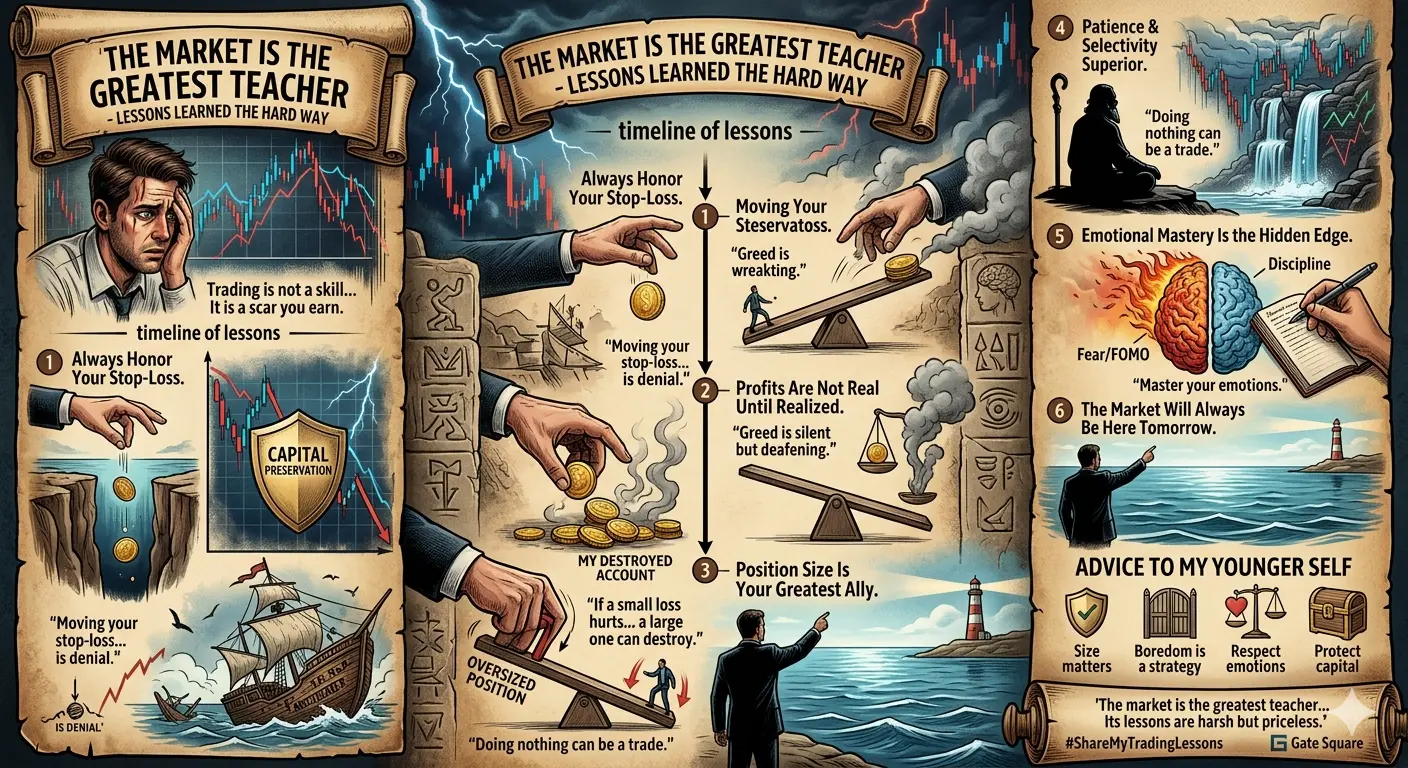
Trading is not a skill you learn from a book. It is a scar you earn from the market. Every candlestick has a story behind it, every chart pattern is a mirror of human emotion, and behind many of my own mistakes, there was a version of me that was overconfident, impatient, or simply unwilling to accept the truth.
The market does not care about your hopes, your analysis, or your justification. It only respects one thing: discipline. And it has a brutal, yet invaluable way of teaching that.
Here are the lessons that the market etched into my mind — lessons I learned through pain, reflection, and a few moments of humility that felt almost existential at the time.
Lesson 1: Always Honor Your Stop-Loss — Capital Preservation Is Everything
Early in my trading journey, I had a habit that almost destroyed everything I had built. Whenever price approached my stop-loss, I would convince myself, “It’s just a wick. It will recover.” Each time I moved my stop-loss lower, I was not being clever — I was lying to myself.
I remember one trade vividly: a leveraged long position that I convinced myself was a minor fluctuation. Hours later, the market dropped sharply — not a small retracement, but a 40% correction that left me staring at a destroyed account.
That day, I realized something critical: moving your stop-loss to avoid a loss is not discipline — it’s denial. Protecting capital is not weakness. It is survival. Your account is your toolbox, and if you destroy it chasing a phantom rebound, you have no tools left to learn, experiment, or grow.
Since that trade, I made one unbreakable rule: the moment a stop-loss is set, it is sacred. Non-negotiable. Non-debatable. Every serious trader must treat their capital as untouchable — because without it, there is no tomorrow.
Lesson 2: Profits Are Not Real Until They Are Realized — Greed Is the Silent Killer
My most painful trade was also my most educational one. It started perfectly: I found a breakout entry where price, volume, and fundamentals aligned. Everything screamed opportunity. I entered confidently, convinced I had found the trade of the month.
Then greed whispered. I removed my take-profit, thinking I could “let it run.” Within hours, my 35% unrealized profit turned into a 12% loss.
This lesson was brutally simple: a profit is not real until it is realized. Greed is silent but deafening — it disguises itself as confidence, ambition, or market insight, but in reality, it only creates risk where none was necessary.
Now, my approach is different. I always lock in partial profits at key levels and let only a portion ride. Protecting gains is just as important as protecting capital. No one ever went broke by taking profits, but many do by chasing illusions.
Lesson 3: Position Size Is Your Greatest Ally — Ego Is Your Worst Enemy
On day one, I wanted to catch every move, trade every setup, and prove myself against the market. The result was predictable: emotional decision-making, sleepless nights, and a series of losses that taught me the hard way why size matters more than entry.
The largest risk in trading is not a bad trade — it is an oversized position that forces you into emotional decisions. If a small loss hurts your heart, a large one can destroy your career. The market will humble you, not because it is cruel, but because it is indifferent.
Lesson 4: Patience and Selectivity Are Superior to Constant Action
Early on, I equated trading with activity — more trades meant more profit, right? Wrong. The best traders are often the quietest, the most selective. They wait. They observe. They prepare. They do not trade out of boredom or FOMO.
I learned that doing nothing can be a trade in itself. Watching the market, observing patterns, studying liquidity, and waiting for setups with high probability is far more effective than chasing every signal. Patience is a skill often overlooked, but it compounds in ways that luck cannot replicate.
Lesson 5: Emotional Mastery Is the Hidden Market Edge
Trading is a mirror of human psychology. Every rise, drop, or consolidation tests your emotions. Fear, greed, impatience, and hope all compete for control.
The day I realized this, I started journaling every trade: not just entry and exit points, but also my emotional state, my reasoning, and my doubts. Over time, I noticed patterns: trades made out of fear or FOMO almost always lost. Trades made with calm, analysis, and discipline succeeded more often than I could have imagined.
Your emotions are the hidden variable in every trading equation. Master them, or they will master you.
Lesson 6: The Market Will Always Be Here Tomorrow — Protect Your Future Self
No trade is worth blowing your account. Missing a rally hurts your ego; losing a large position destroys your future. The market is endless, cyclical, and forgiving — but your account is finite. Protect it. Preserve it. Respect it.
I tell myself this every time I enter a trade: “You do not have to catch every move. You do not have to prove yourself today. The market will always be here tomorrow.”
Advice I Would Give My Younger Self
If I could sit down with the version of me who opened his first trading account, I would say:
Size matters more than entry. Start small, survive long, and grow your account with experience, not luck.
Boredom is a strategy. Trade selectively, wait for high-probability setups, and do not force action.
Respect your emotions. Fear and greed are silent manipulators. Study them, understand them, and let discipline guide your decisions.
Protect your capital at all costs. Without it, there is no future.
Trading has made me humble, patient, and honest with myself in ways nothing else could. It has shown me that success is not measured by wins or losses, but by consistency, reflection, and the courage to stick to your rules even when everything in your mind screams otherwise.
The market is the greatest teacher you will ever have. Its lessons are harsh, unforgiving, and absolute — but for those who listen, reflect, and adapt, they are priceless.
Your story matters. Share it. Every trader’s experience carries value — for themselves, and for someone just starting out who needs to hear the truth before they make the same mistakes.
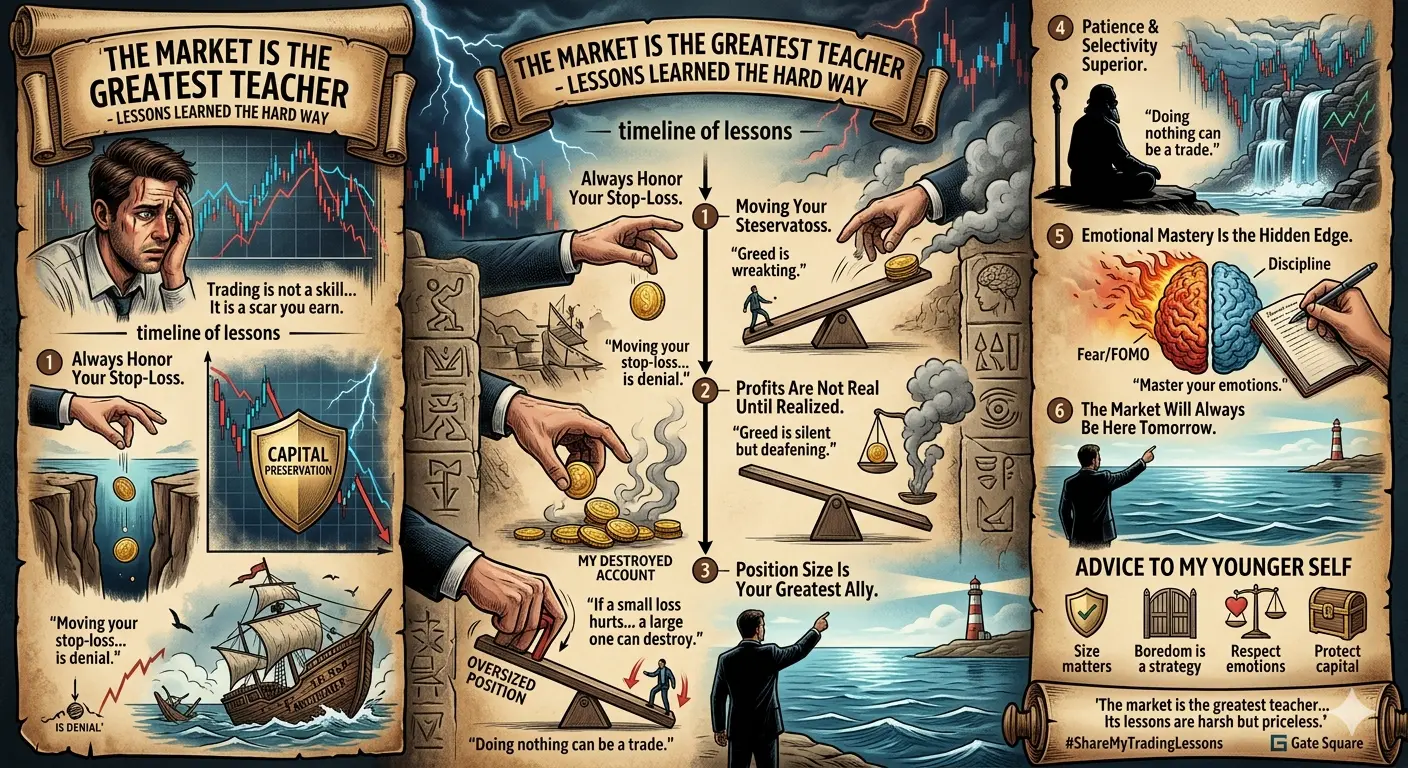
The Market Is the Greatest Teacher — Lessons I Learned the Hard Way
Trading is not a skill you learn from a book. It is a scar you earn from the market. Every candlestick has a story behind it, every chart pattern is a mirror of human emotion, and behind many of my own mistakes, there was a version of me that was overconfident, impatient, or simply unwilling to accept the truth.
The market does not care about your hopes, your analysis, or your justification. It only respects one thing: discipline. And it has a brutal, yet invaluable way of teaching that.
Here are the lessons that the market etched into my mind — lessons I learned through pain, reflection, and a few moments of humility that felt almost existential at the time.
Lesson 1: Always Honor Your Stop-Loss — Capital Preservation Is Everything
Early in my trading journey, I had a habit that almost destroyed everything I had built. Whenever price approached my stop-loss, I would convince myself, “It’s just a wick. It will recover.” Each time I moved my stop-loss lower, I was not being clever — I was lying to myself.
I remember one trade vividly: a leveraged long position that I convinced myself was a minor fluctuation. Hours later, the market dropped sharply — not a small retracement, but a 40% correction that left me staring at a destroyed account.
That day, I realized something critical: moving your stop-loss to avoid a loss is not discipline — it’s denial. Protecting capital is not weakness. It is survival. Your account is your toolbox, and if you destroy it chasing a phantom rebound, you have no tools left to learn, experiment, or grow.
Since that trade, I made one unbreakable rule: the moment a stop-loss is set, it is sacred. Non-negotiable. Non-debatable. Every serious trader must treat their capital as untouchable — because without it, there is no tomorrow.
Lesson 2: Profits Are Not Real Until They Are Realized — Greed Is the Silent Killer
My most painful trade was also my most educational one. It started perfectly: I found a breakout entry where price, volume, and fundamentals aligned. Everything screamed opportunity. I entered confidently, convinced I had found the trade of the month.
Then greed whispered. I removed my take-profit, thinking I could “let it run.” Within hours, my 35% unrealized profit turned into a 12% loss.
This lesson was brutally simple: a profit is not real until it is realized. Greed is silent but deafening — it disguises itself as confidence, ambition, or market insight, but in reality, it only creates risk where none was necessary.
Now, my approach is different. I always lock in partial profits at key levels and let only a portion ride. Protecting gains is just as important as protecting capital. No one ever went broke by taking profits, but many do by chasing illusions.
Lesson 3: Position Size Is Your Greatest Ally — Ego Is Your Worst Enemy
On day one, I wanted to catch every move, trade every setup, and prove myself against the market. The result was predictable: emotional decision-making, sleepless nights, and a series of losses that taught me the hard way why size matters more than entry.
The largest risk in trading is not a bad trade — it is an oversized position that forces you into emotional decisions. If a small loss hurts your heart, a large one can destroy your career. The market will humble you, not because it is cruel, but because it is indifferent.
Lesson 4: Patience and Selectivity Are Superior to Constant Action
Early on, I equated trading with activity — more trades meant more profit, right? Wrong. The best traders are often the quietest, the most selective. They wait. They observe. They prepare. They do not trade out of boredom or FOMO.
I learned that doing nothing can be a trade in itself. Watching the market, observing patterns, studying liquidity, and waiting for setups with high probability is far more effective than chasing every signal. Patience is a skill often overlooked, but it compounds in ways that luck cannot replicate.
Lesson 5: Emotional Mastery Is the Hidden Market Edge
Trading is a mirror of human psychology. Every rise, drop, or consolidation tests your emotions. Fear, greed, impatience, and hope all compete for control.
The day I realized this, I started journaling every trade: not just entry and exit points, but also my emotional state, my reasoning, and my doubts. Over time, I noticed patterns: trades made out of fear or FOMO almost always lost. Trades made with calm, analysis, and discipline succeeded more often than I could have imagined.
Your emotions are the hidden variable in every trading equation. Master them, or they will master you.
Lesson 6: The Market Will Always Be Here Tomorrow — Protect Your Future Self
No trade is worth blowing your account. Missing a rally hurts your ego; losing a large position destroys your future. The market is endless, cyclical, and forgiving — but your account is finite. Protect it. Preserve it. Respect it.
I tell myself this every time I enter a trade: “You do not have to catch every move. You do not have to prove yourself today. The market will always be here tomorrow.”
Advice I Would Give My Younger Self
If I could sit down with the version of me who opened his first trading account, I would say:
Size matters more than entry. Start small, survive long, and grow your account with experience, not luck.
Boredom is a strategy. Trade selectively, wait for high-probability setups, and do not force action.
Respect your emotions. Fear and greed are silent manipulators. Study them, understand them, and let discipline guide your decisions.
Protect your capital at all costs. Without it, there is no future.
Trading has made me humble, patient, and honest with myself in ways nothing else could. It has shown me that success is not measured by wins or losses, but by consistency, reflection, and the courage to stick to your rules even when everything in your mind screams otherwise.
The market is the greatest teacher you will ever have. Its lessons are harsh, unforgiving, and absolute — but for those who listen, reflect, and adapt, they are priceless.
Your story matters. Share it. Every trader’s experience carries value — for themselves, and for someone just starting out who needs to hear the truth before they make the same mistakes.